Sales Hiring Assessment: How to Screen SDRs, BDRs, and Account Executives
Build a better sales hiring assessment with structured video screening questions, scorecards, and practical evaluation criteria for SDR, BDR, and account executive hiring.
A strong sales hiring assessment combines a short role-specific video screen, a consistent scorecard, and a practical sales exercise. Ask every candidate the same questions about prospecting, discovery, objection handling, and measurable results, then review the evidence with resume details before inviting finalists to a live role-play. VideoPitcher helps hiring teams create this structured assessment workflow for SDR, BDR, account executive, and sales representative hiring across India and global markets.
Key Takeaways
- ✓Use video screening to evaluate early signals such as communication, customer understanding, motivation, and sales process.
- ✓Ask the same core questions for every candidate so the comparison is based on evidence, not interview chemistry.
- ✓Use a scorecard with observable criteria for prospecting, discovery, objection handling, and measurable outcomes.
- ✓Keep the first-round screen short, accessible, mobile-friendly, and easy to complete across time zones.
- ✓Combine video answers with resume evidence, a sales work sample, and a human-led final decision.
- ✓Adapt examples for India, international markets, language requirements, customer segments, and working hours without changing the core evaluation standard.
Why Sales Hiring Needs a Better First Round
A resume can show targets, titles, industries, and years of experience. It usually cannot show how a candidate listens to a customer, explains a complex product, responds to an objection, or learns from a lost deal. Those signals matter in sales, but traditional screening often tries to discover them through a long chain of phone calls and calendar coordination.
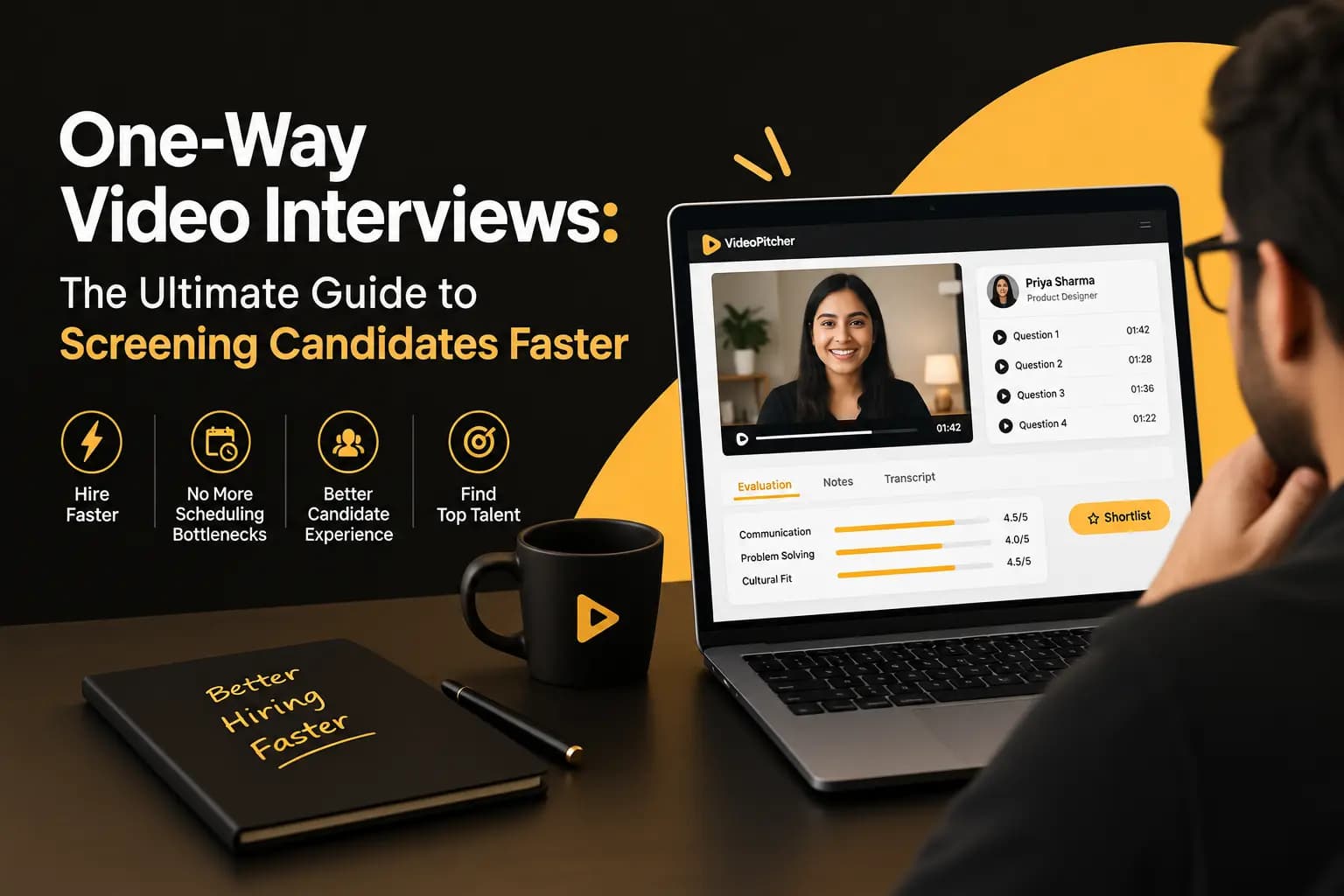
A structured video screen adds useful context earlier. Candidates can answer the same role-relevant questions on their own schedule, while hiring teams can review responses in batches and use a common rubric. The goal is not to hire from a video alone. The goal is to protect live interview time for candidates who show enough evidence to move forward.
Where Video Screening Fits in the Sales Hiring Process
- ✓Define the role scorecard: separate essential sales behaviors from preferred experience and set a clear pass standard.
- ✓Review applications: confirm relevant market, product, customer, quota, and territory experience without relying on job title alone.
- ✓Send the video screen: invite qualified applicants to complete three to five consistent questions with clear instructions.
- ✓Review and score: assess evidence against the rubric and record a brief reason for advancing or declining each candidate.
- ✓Run a deeper assessment: use a live interview, discovery role-play, or account plan for shortlisted candidates.
- ✓Make a complete decision: consider skills, experience, references, compensation alignment, and the candidate's questions about the role.
The 6 Best Sales Video Screening Questions
1. Tell us about a deal you are proud of. What was the customer problem, what did you do, and what was the result?
This reveals ownership, discovery depth, sales process, and whether the candidate can explain a result with evidence.
2. How do you prepare for a first conversation with a prospect?
Strong answers show research habits, customer curiosity, prioritization, and an understanding that discovery is not a product monologue.
3. A prospect says the price is too high. How would you respond?
Look for clarification, value discovery, calm communication, and the ability to avoid discounting before understanding the objection.
4. Tell us about a deal you lost. What did you learn and what did you change afterward?
This tests reflection, coachability, accountability, and whether the candidate can turn a setback into a better sales habit.
5. How do you prioritize your pipeline when several opportunities need attention?
The answer can show qualification discipline, forecasting judgment, time management, and comfort working with a measurable process.
6. What would you want to learn in your first 30 days in this sales role?
This highlights preparation, learning agility, expectations, and whether the candidate understands the market and customer context they are entering.
| Question design principle | What to do |
|---|---|
| One competency per question | Make it clear what the candidate is being asked to demonstrate. |
| Ask for evidence | Prompt for the action, context, and result rather than opinions alone. |
| Keep the format consistent | Use the same time limit and instructions for every candidate. |
Sales Interview Scorecard Template
| Competency | What to look for | Suggested weight |
|---|---|---|
| Customer understanding | Connects the buyer problem to a relevant action or outcome | 25% |
| Sales process | Explains a repeatable approach to prospecting, discovery, and follow-up | 20% |
| Objection handling | Clarifies the concern and responds with value rather than pressure | 20% |
| Evidence of results | Uses specific targets, actions, and outcomes where appropriate | 15% |
| Communication structure | Gives a concise answer with a clear beginning, middle, and result | 10% |
| Learning mindset | Reflects honestly and explains how feedback changed behavior | 10% |
Use a simple rating scale such as 1 to 5 for each competency and require written evidence for every score. Reviewers should score what the candidate said and did, not their accent, appearance, background, recording quality, or perceived personality. A structured scorecard is only useful when the criteria are job-related and applied consistently.
How to Hire Sales Representatives in India and Globally
A distributed sales hiring process needs consistency and local context. Keep the core competencies the same across locations, then adapt the examples and practical requirements for the market. For India-based hiring, you may need to clarify language expectations, customer segment, territory, shift timing, and whether the role is inside sales, field sales, or international business development.
- ✓Use asynchronous invitations so candidates in different cities and time zones can complete the screen without waiting for a calendar slot.
- ✓State the expected language, customer segment, working hours, travel requirements, and compensation structure before the candidate records an answer.
- ✓Use the same core scorecard for India and global applicants, but accept market-specific examples and selling motions.
- ✓Provide a practice question and clear time limits so the process measures sales thinking rather than familiarity with the recording tool.
- ✓Give candidates a realistic timeline for feedback and close the loop after the screen.
Common Mistakes to Avoid
- ✓Asking generic questions that do not reveal how the candidate sells, qualifies, or learns.
- ✓Making the assessment too long or requiring candidates to repeat information already provided in the application.
- ✓Scoring confidence, camera quality, or accent instead of job-related evidence.
- ✓Using AI output as an automatic rejection instead of reviewing the underlying answer and context.
- ✓Changing the questions or scoring standard from one candidate to the next without documenting why.
- ✓Skipping a live conversation or role-play for finalists when interaction itself is important to the sales role.
Why VideoPitcher
VideoPitcher gives recruiting and sales leaders a practical way to create structured candidate screens, collect video responses, and review applicants with more context than a resume alone. Teams can combine screening questions, candidate responses, assessments, and shared evaluation criteria in one hiring workflow, making it easier to compare applicants across locations and hiring managers.
Build a repeatable sales hiring workflow: create a focused sales assessment, invite candidates asynchronously, and give your hiring team a consistent way to review the first round. Create your first assessment and get 20 free credits.
Conclusion
The strongest sales hiring process does not try to make one screening step predict everything. It creates the right evidence at each stage. Use video screening to understand communication, customer thinking, motivation, and sales judgment early. Then use structured interviews, work samples, and human decision-making to confirm whether the candidate can succeed in your market and sales environment.
Scorecard — implementation checklist
- Define the sales competencies and pass criteria before opening the role
- Write three to five questions tied to real sales behaviors
- Include a practice response and clear candidate instructions
- Use a shared scorecard with job-related evidence
- Review video responses alongside resumes and assessments
- Adapt market examples for India and international hiring without changing the core standard
- Use a live interview or role-play for shortlisted candidates
- Give candidates a clear timeline and respectful communication
Frequently asked questions
Why use video screening when hiring sales representatives?+
Video screening provides consistent evidence about communication, customer understanding, motivation, and sales thinking before a live interview. It should support, not replace, structured interviews and human judgment.
What are the best sales representative interview questions?+
Ask candidates about a measurable sales win, prospecting preparation, objection handling, a lost deal, pipeline prioritization, and what they would learn during their first 30 days.
How long should a sales video screening take?+
Keep the first-round screen to roughly 10 to 15 minutes with three to five focused questions. Clear instructions and a practice question improve the candidate experience.
Can VideoPitcher be used for remote sales hiring?+
Yes. An asynchronous workflow lets candidates complete the first-round screen across cities and time zones, while hiring teams use shared questions and scorecards to compare responses consistently.
How do I avoid bias in sales video interviews?+
Use the same questions, define job-related criteria in advance, require evidence for scores, and evaluate the content of answers rather than appearance, accent, camera quality, or charisma alone.
Written by VideoPitcher Editorial Team
Talent Acquisition & HR Technology Desk
Published August 21, 2026
Keywords covered
Related resources
Ready to transform your hiring process?
Start using VideoPitcher today with 20 FREE AI Video Screening Credits, plus Unlimited AI Resume Analysis and Unlimited Text Screening Assessments. No credit card is required—just start screening smarter and find the right candidates faster.