Async Video Screening for Faster Hiring
Async video screening removes scheduling bottlenecks, standardizes early evaluation, and eliminates the calendar friction that causes candidates to ghost first-round interviews. Here's the full framework.
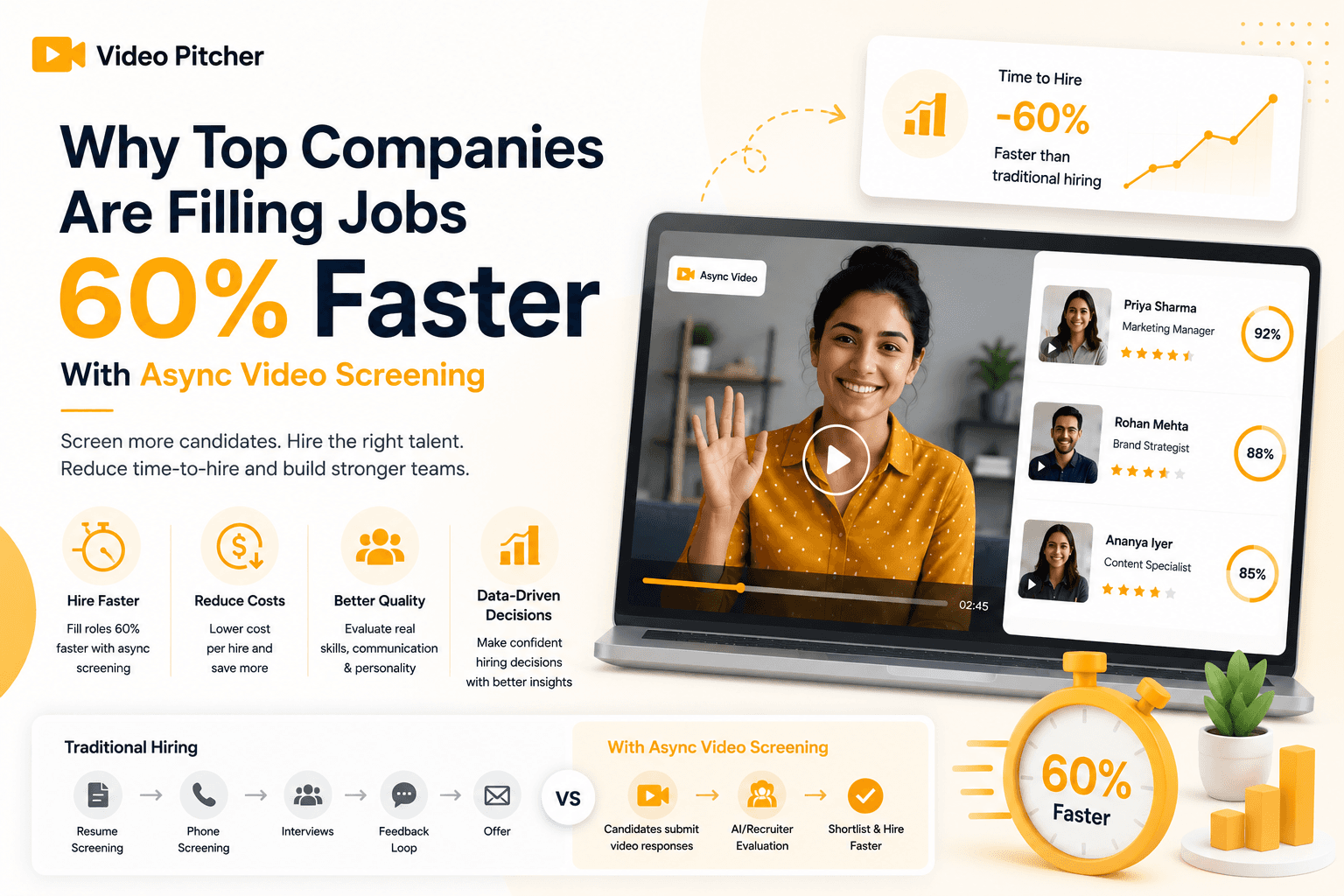
Async video screening replaces scheduled first-round phone calls with structured video and text assessments candidates complete on their own time. This removes the calendar-coordination delay that causes most first-round candidate ghosting, and lets hiring teams review submissions in batches instead of one call at a time — commonly cutting time-to-hire by 40 to 60 percent.
Most hiring teams don't lose time because they can't evaluate candidates. They lose time because they can't coordinate calendars. A 'quick 20-minute screen' turns into a 4-day scheduling thread, then a reschedule, then a candidate who goes silent. Multiply that by 30 applicants and the role stays open for weeks longer than it should — and somewhere in that delay, your strongest candidates quietly accept another offer.
Top companies fix this by replacing early-stage live calls with asynchronous video screening. Candidates respond on their own time, hiring managers review in focused batches, and the two biggest failure modes of a slow funnel — long time-to-hire and candidate ghosting — get solved by the same structural change, because they share the same root cause: scheduling friction.
This guide covers the full picture: why the scheduling step is the real bottleneck, why candidates ghost first-round interviews specifically, the implementation framework top teams use, and the metrics that tell you whether it's actually working.
The Real Bottleneck: Scheduling, Not Screening
A live screen is rarely just 20 minutes. It's also calendar coordination, email back-and-forth, time zone mismatch, and rescheduling. If you run three rounds of live interviews, your process becomes a scheduling system, not an evaluation system.
Async video screening removes the scheduling dependency entirely. Candidates record when they're ready; reviewers watch when they have a gap. This decoupling is the single biggest reason time-to-hire drops, and it's also — as the next section covers — the biggest reason candidate ghosting drops with it.
Why Candidates Ghost First-Round Interviews
The common assumption when a candidate ghosts is that they were never serious. This is rarely true. Candidates ghost for structural and situational reasons, not motivational ones: they accepted a competing offer while your scheduling window was still open, the friction of attending a live call outweighed their interest at that exact moment, or they received no clear signal about what the interview would involve, making it feel like a high-risk, low-reward use of their time.
Scheduling delay is the single biggest driver. When the average time between application and first-round invite is five or more days, candidates lose the momentum that drove them to apply in the first place. Every day between 'apply' and 'first interaction' is a window where you're competing against faster-moving recruiters — and async screening closes that window from days to hours.
There's also an asymmetry-of-effort problem: asking a candidate to block 30 minutes for a call with a stranger, one that might end in immediate disqualification, creates outsized perceived risk, especially for currently-employed candidates managing that call around their existing job. A 10-minute assessment they complete privately, on their own schedule, removes that risk entirely.
The Async Fix: Removing the Live Call From Round One
Instead of booking a call to determine baseline fit, send candidates a structured video and text assessment immediately after they apply. The link is accessible 24/7, takes 10 to 15 minutes, and requires no calendar coordination.
This isn't just a convenience upgrade — it changes the candidate's psychological calculus. A high-stakes synchronous commitment becomes a low-stakes asynchronous task. Completion rates for well-designed async assessments run 40–60% on public links and 70–85% on private links, consistently higher than first-round call attendance rates in most pipelines. And the candidates who do complete it have already demonstrated real intent, which is itself a strong early signal.
Batch Review Creates Hiring 'Parallel Processing'
Live interviews force serial evaluation: one candidate, one meeting, one block of calendar time. Async screening enables parallel processing — you can review 10 candidates in the same block of time a single phone screen would have taken.
Batch review also improves comparison quality. When the same prompts are answered by every candidate, hiring managers can spot signal faster and align on who deserves a deeper interview, which is a major reason async screening often improves shortlist quality, not just speed.
Standardized Prompts Reduce False Positives
Unstructured phone screens create inconsistent data — different questions, different interviewer moods, different thresholds. That inconsistency produces both false positives (candidates who advanced on rapport) and false negatives (strong candidates asked the wrong questions).
Async screening works best paired with a consistent question set and a simple scoring rubric. For a starting point, see the interview question and scoring guide.
Communication Architecture: How You Invite Determines Who Shows Up
How you word the invitation is one of the most underrated levers here. A generic 'let's schedule a call' invite forces the candidate to do work (compare calendars, pick a slot) while giving them no new information about what to expect — and ghosting becomes the path of least resistance.
A converting invitation answers four things immediately: why you're reaching out to this specific person, what the next step involves, how long it takes, and what happens after. Pair this with a single automated, low-pressure reminder 24 hours after a candidate opens but doesn't finish the assessment — this alone recovers 20–30% of abandoned sessions.
Funnel Design: Structuring Your Pipeline to Reward Fast Movers
Ghosting spikes when your pipeline is slow and unpredictable. Elite candidates are evaluating several opportunities at once, and the employer who moves fastest and communicates most clearly usually wins. Define a maximum time-to-review SLA (e.g., 'all submitted assessments reviewed within 48 hours') so the pipeline never stagnates between the assessment and the next step.
A one-line automated confirmation after submission — 'Thanks for completing the assessment; we'll follow up by [date]' — validates the candidate's effort and removes the ambiguity where ghosting tends to fester.
Measuring Success: The Metrics That Actually Matter
Track first-round completion rate as your baseline before changing anything, then change one variable at a time — a new email template, a shorter assessment, a different distribution method — so you can attribute improvement correctly.
Track no-show rates on scheduled live interviews separately from assessment completion rates; they're different problems with different fixes. Reference benchmarks: strong teams typically see 50–60% completion on public links, 75–85% on private links, and under 10% no-show rates on live interviews once async pre-screening is in place.
Where Async Screening Fits (and Where It Doesn't)
Async screening is ideal for validating baseline fit: communication clarity, role understanding, motivation, and job-relevant examples — especially for high-volume roles and distributed time zones. It is not a replacement for final-round interviews where collaboration, deep technical evaluation, and mutual decision-making matter. The best teams use async screening to protect live interview time for finalists, rather than spending it on early-stage qualification calls.
Scorecard — implementation checklist
- Replace first-round phone screens with a 10–15 minute async screening stage
- Use 3–5 prompts total: 1–2 text knockout questions + 2–3 short video prompts
- Send the assessment link within 24 hours of application to capture peak candidate intent
- Set a clear review SLA for hiring managers (e.g., review within 24–48 hours)
- Send a submission confirmation immediately so candidates know what happens next
- Set up a 24-hour automated reminder for candidates who open but don't complete the link
- Score responses with a simple, shared rubric to keep decisions consistent
- Batch-review candidates in focused blocks instead of scheduling individual calls
- Move only finalists to live interviews — protect live time for high-signal evaluation
- Track completion rate, time-to-first-screen, and live-interview no-show rate separately
Frequently asked questions
What is async video screening?+
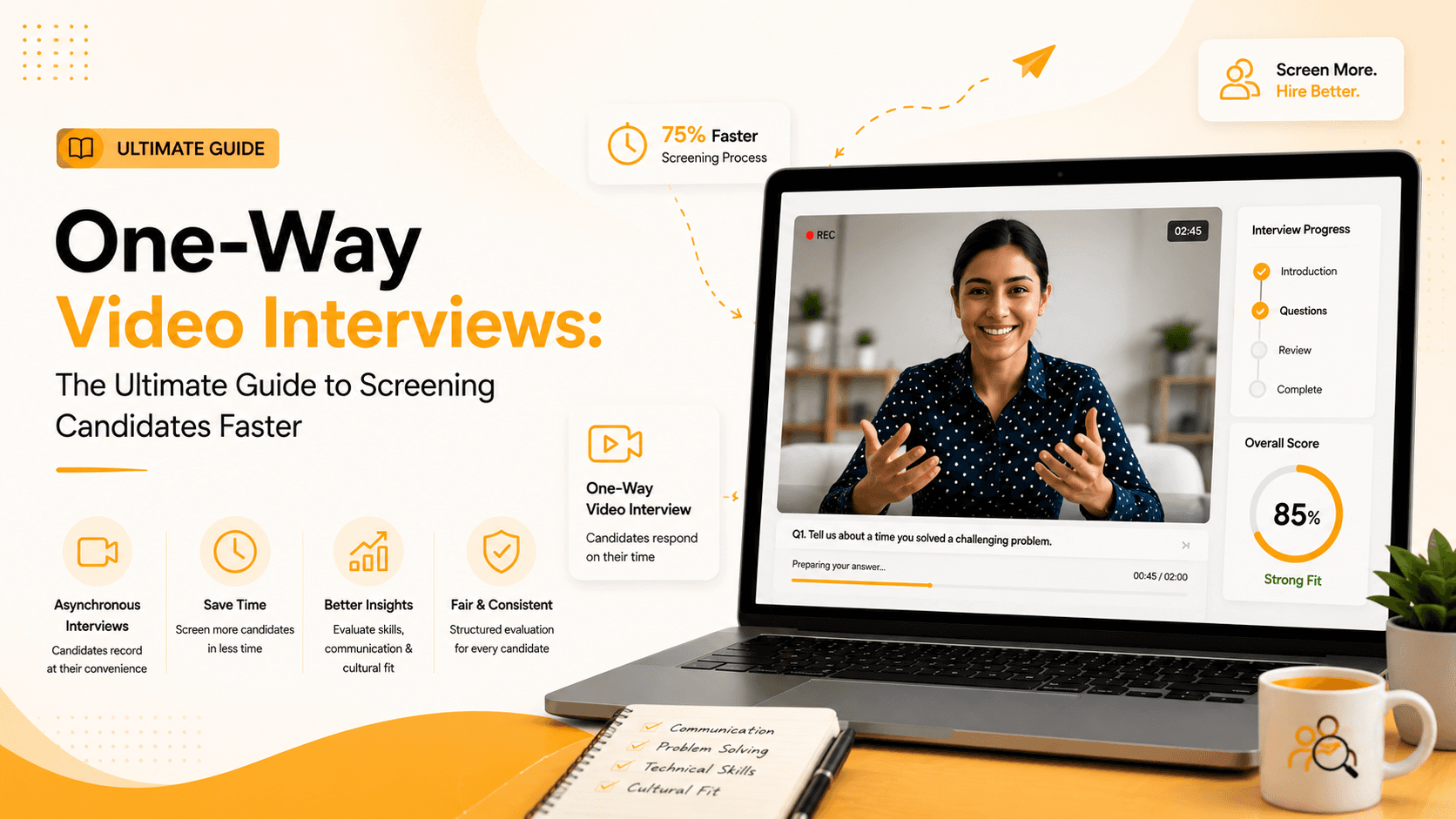
Async video screening is a first-round hiring step where candidates record short video and text responses to structured prompts on their own schedule. Hiring teams review the responses later, score consistently, and advance top candidates to live interviews.
How does async screening reduce time-to-hire by up to 60%?+
It removes calendar coordination from early-stage screening. Candidates complete the screen immediately after applying, and teams review in batches rather than scheduling separate calls, eliminating the multi-day gaps between steps that make up most of a slow hiring cycle.
Why do candidates ghost first-round interviews?+
Most ghosting is structural, not a character issue: candidates accept a competing offer during a slow scheduling window, the effort of attending a live call outweighs their interest at that moment, or they don't know what the interview involves and treat it as low-value. Async screening addresses all three by removing the scheduling step itself.
What's the best way to follow up with a candidate who hasn't completed an assessment?+
A single warm, low-pressure automated reminder sent 24 hours after the link is opened but not completed recovers 20–30% of abandoned assessments. Keep it brief and pressure-free: 'No worries if you got busy — the link is still live whenever you're ready.'
How long should an async screening be?+
Target 10–15 minutes total: 1–2 short text knockout questions and 2–3 video prompts at 60–90 seconds each. Longer assessments cause meaningful drop-off, especially on public links.
Does async screening replace live interviews entirely?+
No. It replaces low-signal early-stage phone screens. Live interviews still matter for deep competency evaluation, team collaboration, and mutual decision-making in later rounds — async screening exists to protect that time for finalists.
Written by VideoPitcher Team
Recruitment Product & Research
The VideoPitcher team writes about hiring workflows, candidate assessment, and what we learn building the product.
Published May 28, 2026 • Updated July 27, 2026
Keywords covered
Related resources
Ready to transform your hiring process?
Start using VideoPitcher today with 20 FREE AI Video Screening Credits, plus Unlimited AI Resume Analysis and Unlimited Text Screening Assessments. No credit card is required—just start screening smarter and find the right candidates faster.