How to Practice for a Video Interview Alone: A Step-by-Step Method That Actually Works
Learn how to practice for a video interview alone, record better answers, improve communication, reduce filler words, build confidence, and prepare for your next interview without needing a practice partner.
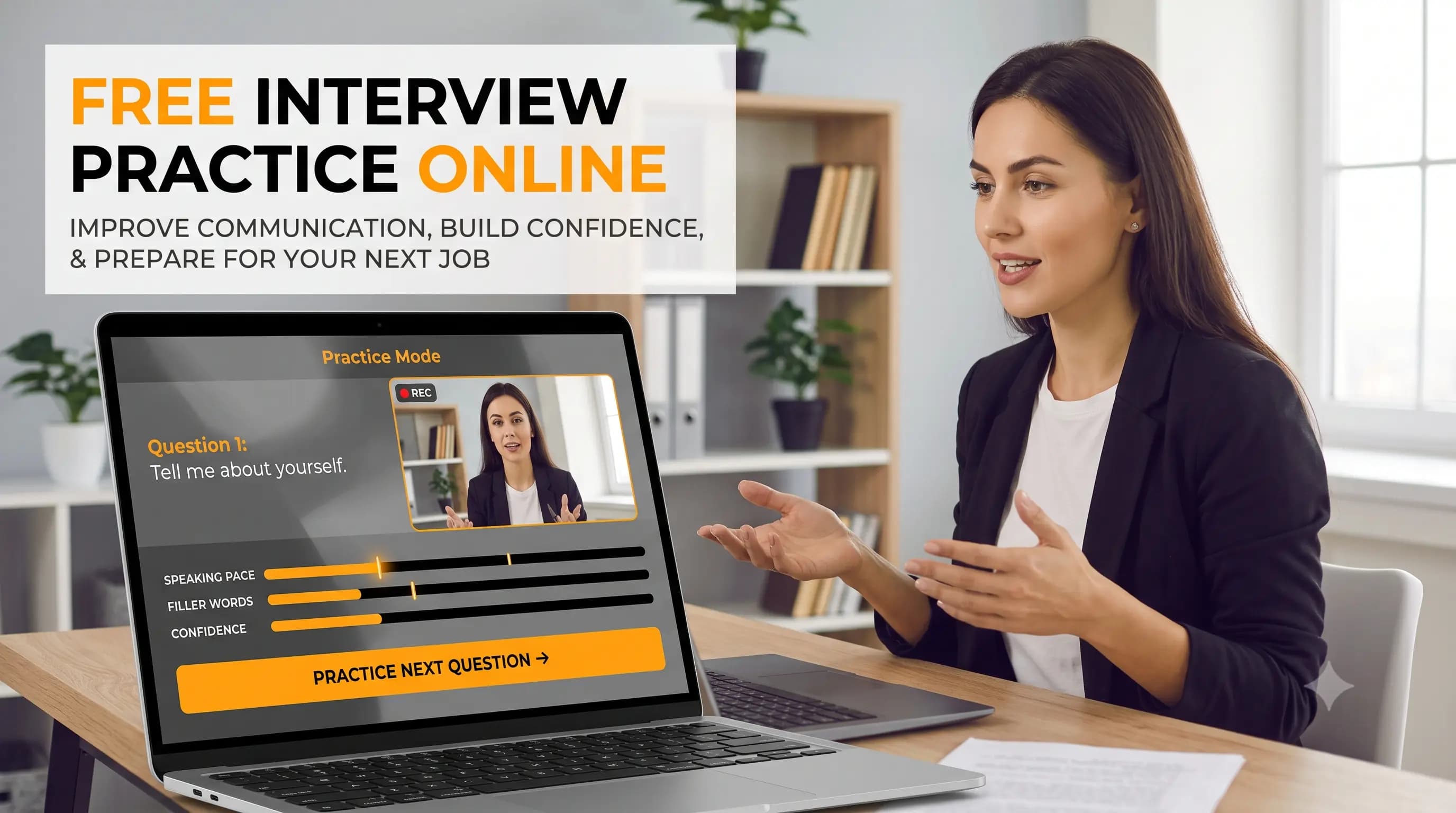
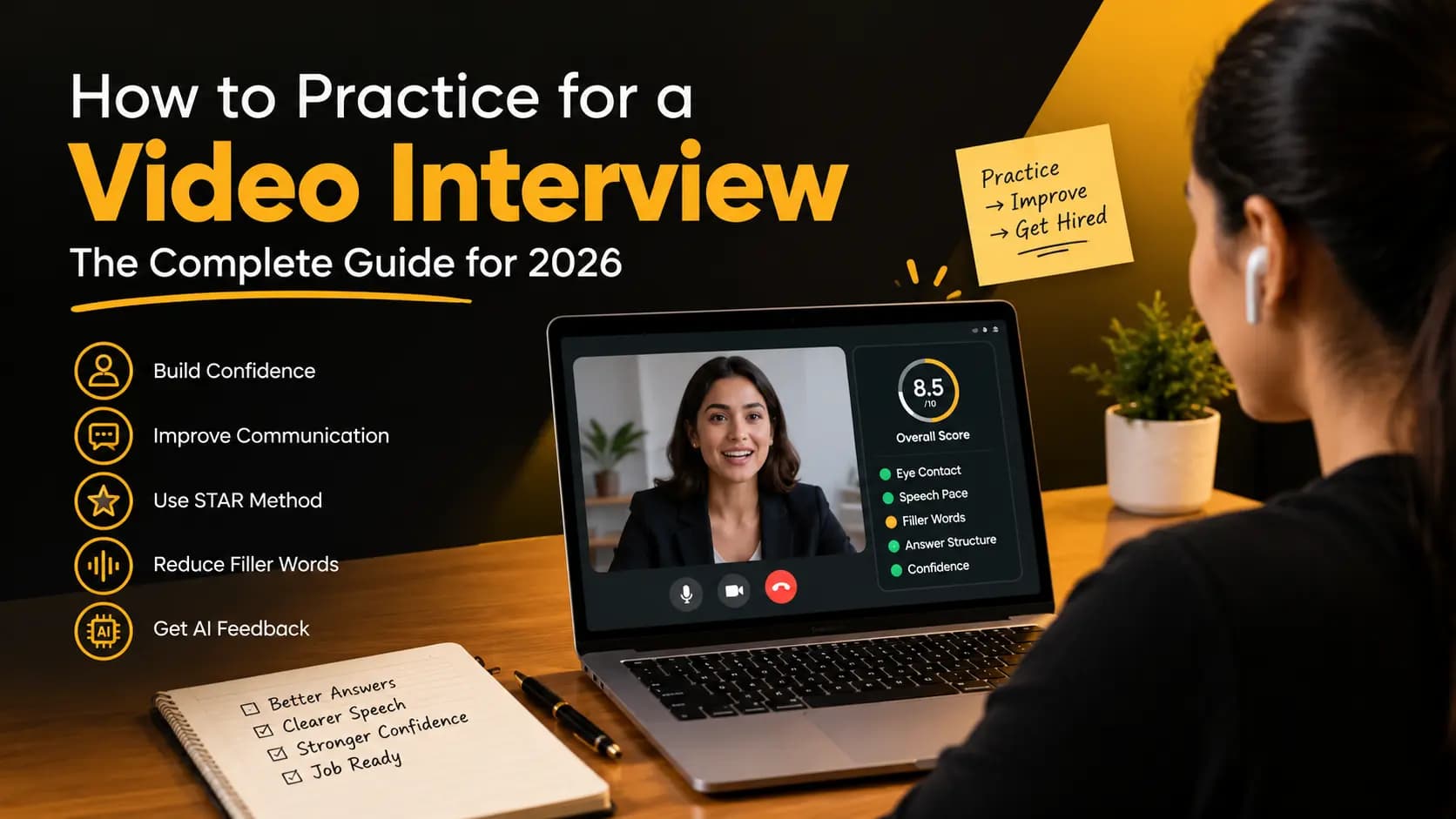
You can practice for a video interview alone by choosing questions relevant to the role, answering them on camera, reviewing your recording, identifying one or two specific weaknesses, and recording the answer again. Focus on answer structure, communication clarity, speaking pace, filler words, eye contact, confidence, and overall delivery rather than memorizing complete answers. A free video interview practice tool can make this process easier by giving you interview questions and structured feedback without requiring another person to conduct the practice session.
Preparing for a video interview can feel difficult when you do not have someone available to practice with. You may read interview questions, prepare notes, research the company, and think through your answers, but none of those activities fully replaces actually speaking your answers out loud.
The good news is that you do not need a friend, colleague, recruiter, or career coach to practice effectively. You can practice a video interview by yourself using a laptop or phone camera, a list of relevant questions, and a simple repeatable process: answer, record, review, improve, and answer again.
Practicing alone can also reveal things that are difficult to notice when you are only thinking about an answer. You may discover that you speak faster than expected, use filler words frequently, avoid looking at the camera, give answers that are too long, or struggle to explain your experience in a clear structure.
This guide explains exactly how to practice for a video interview alone, what questions to practice, how to record yourself, what to look for when reviewing your answers, how to improve your delivery, and how a free video interview practice tool can make the process more structured.
Key Takeaways
- ✓You do not need another person to start practicing for a video interview.
- ✓Speaking your answers aloud is more useful than only reading or thinking about possible responses.
- ✓Recording yourself helps you notice communication habits that may be difficult to recognize while answering.
- ✓Practice should include common, behavioral, difficult, and role-specific interview questions.
- ✓Do not memorize complete answers. Prepare key points and practice explaining them naturally.
- ✓Review your speaking pace, filler words, eye contact, confidence, clarity, posture, and answer structure.
- ✓After every practice answer, identify one or two specific improvements instead of trying to fix everything at once.
- ✓Repeat the same question after making an improvement so you can compare your delivery.
- ✓A realistic video practice environment can help you become more comfortable answering questions on camera.
- ✓Free AI interview practice can provide a structured way to practice without depending on another person.
Can You Really Practice for a Video Interview Alone?
Yes. You can build a useful video interview practice routine without having a friend, colleague, mentor, recruiter, or career coach available.
The key is to stop treating interview preparation as something you only do inside your head. Thinking about an answer is different from actually saying it. When you speak, you have to organize your thoughts, choose your words, control your pace, maintain eye contact with the camera, and finish your answer clearly.
That is why recording yourself is such a useful part of practicing alone. You can see and hear what the interviewer would experience instead of relying only on how your answer felt while you were giving it.
A simple practice cycle works well: choose a question, answer it, record yourself, review the recording, identify one weakness, and answer the question again.
Why Practicing Alone Can Be Better Than Only Reading Interview Questions
Reading interview questions is useful for understanding what you might be asked. However, reading does not tell you how you sound when you answer.
You may think you have a strong answer prepared, but once you start speaking you might discover that your explanation is too long, your introduction is unclear, or you keep using the same filler words.
You might also notice that your speaking pace changes when you discuss something difficult. You may begin speaking quickly, lose your structure, or look away from the camera while trying to remember what to say.
Reading prepares your ideas. Speaking prepares your delivery.
- ✓Reading interview questions helps you understand possible topics.
- ✓Writing notes helps you organize important experiences and examples.
- ✓Speaking answers helps you practice explaining those ideas naturally.
- ✓Recording helps you see how your communication actually looks and sounds.
- ✓Reviewing helps you identify specific weaknesses.
- ✓Repeating the answer helps turn feedback into improvement.
Step 1: Choose the Job You Are Preparing For
Do not begin your practice by randomly answering dozens of interview questions. Start with the specific role you want.
The questions you need to practice can change depending on the job, industry, seniority, and responsibilities. A software developer may need to explain technical decisions and projects, while a sales candidate may need to demonstrate communication, persuasion, and customer-handling skills.
Read the job description and identify the skills, responsibilities, and experiences that appear most important. Use those areas to decide which interview questions you should practice.
Before you start practicing, identify:
- ✓The exact job title.
- ✓The seniority level.
- ✓The most important skills in the job description.
- ✓The responsibilities you will likely be asked about.
- ✓The projects or achievements from your background that are most relevant.
- ✓The behavioral situations that demonstrate the required skills.
Step 2: Build Your Interview Question List
Once you understand the role, create a small practice set instead of trying to prepare for every interview question that exists.
A good practice session can include a mixture of general, behavioral, role-specific, and difficult questions. This makes your preparation more realistic because you will not know exactly what type of question comes next during the real interview.
| Question Type | Examples |
|---|---|
| Introduction | Tell me about yourself. Walk me through your background. |
| Motivation | Why do you want this role? Why do you want to work here? |
| Experience | Tell me about your most important project or achievement. |
| Behavioral | Tell me about a time you solved a difficult problem. |
| Situational | What would you do if you disagreed with a teammate? |
| Role-specific | Explain a skill, process, tool, or decision relevant to the job. |
| Difficult | What is your biggest weakness? Why should we hire you? |
Step 3: Prepare Key Points Instead of a Full Script
One of the biggest mistakes candidates make when practicing alone is writing a perfect answer and then trying to memorize every sentence.
A memorized answer may sound good during practice, but it can become difficult to adapt when the interviewer asks the question differently. You may also lose your place if you forget one sentence.
Instead, prepare a few key points that you want to communicate. Then practice explaining those points in your own words.
For each important question, prepare:
- ✓The main point you want the interviewer to remember.
- ✓One or two relevant examples.
- ✓Important numbers or measurable results.
- ✓Your personal contribution.
- ✓The outcome or lesson.
This approach gives you enough preparation to stay focused without making your answer sound like you are reading from a script.
Step 4: Set Up Your Camera Before You Practice
If the real interview will happen through video, practice in a video environment. You do not need expensive equipment. A laptop or phone with a working camera can be enough to begin.
Check your setup:
- ✓Position the camera approximately at eye level.
- ✓Make sure your face is clearly visible.
- ✓Use a quiet environment with minimal distractions.
- ✓Check that your microphone records your voice clearly.
- ✓Keep your background clean and professional.
- ✓Make sure your internet connection is stable if you are using an online practice tool.
- ✓Close unnecessary notifications and applications.
- ✓Sit in a comfortable position that allows natural posture.
The purpose is not to create a perfect studio. The purpose is to remove avoidable distractions so you can focus on your interview answer.
Step 5: Start With One Question
Do not try to complete a full interview immediately. Start with one question.
Choose something common, such as 'Tell me about yourself.' Give yourself a few seconds to think and then answer naturally. Do not stop the recording simply because you made a small mistake.
The goal of the first recording is not perfection. It is to create a realistic baseline that you can review.
Step 6: Record Your Answer on Camera
Recording changes the practice experience because you are no longer simply imagining an interview. You have to communicate with a camera as if another person were listening.
Try to look toward the camera naturally, speak at a comfortable pace, and answer the question directly. If you forget a word or make a small mistake, continue. Real interviews are conversations, not perfectly edited videos.
During your recording, pay attention to:
- ✓Whether you start answering too quickly.
- ✓Whether your answer directly addresses the question.
- ✓Whether you maintain natural eye contact with the camera.
- ✓Whether your voice is clear enough to understand.
- ✓Whether you use frequent filler words.
- ✓Whether you speak too quickly or too slowly.
- ✓Whether your answer has a clear beginning, middle, and end.
- ✓Whether your posture remains natural and professional.
Step 7: Watch Your Recording Like an Interviewer
This is one of the most important steps in practicing alone. Do not immediately record the answer again. First, review what you just did.
Try to watch the recording from the perspective of someone who has never heard your answer before. Ask whether the message is clear, whether the answer stays focused, and whether your delivery makes the information easy to follow.
Ask yourself these questions:
- ✓Did I answer the question directly?
- ✓Was my first sentence clear?
- ✓Did I explain the most important point early enough?
- ✓Did I give a specific example?
- ✓Did I explain my own contribution?
- ✓Did I mention the result?
- ✓Was I speaking too quickly?
- ✓Did I use unnecessary filler words?
- ✓Did I look toward the camera naturally?
- ✓Did I sound confident and engaged?
- ✓Was my answer too short or too long?
- ✓Did I finish with a clear point?
Step 8: Identify Only One or Two Things to Improve
It can be tempting to watch your recording and create a long list of everything you think is wrong. That usually makes practice overwhelming.
Instead, choose one or two improvements that would make the biggest difference. For example, if your answer is strong but you use filler words frequently, make filler words your focus for the next attempt.
| If You Notice | Focus On |
|---|---|
| You speak very quickly | Pause before answering and between major points. |
| Too many filler words | Replace unnecessary fillers with short silent pauses. |
| Answers are too long | Lead with the main point and remove unrelated details. |
| Answers lack structure | Use a simple framework such as STAR for behavioral questions. |
| You look away frequently | Practice returning your attention naturally to the camera. |
| Your delivery sounds flat | Use natural voice variation and emphasize important points. |
| You lose your train of thought | Prepare key points instead of memorizing complete sentences. |
Step 9: Record the Same Answer Again
This is where practice becomes improvement. After identifying a specific weakness, answer the same question again.
Do not simply repeat the previous response. Apply the change you identified. If you were speaking too quickly, consciously slow down. If your answer lacked structure, organize it into clear points. If you used too many filler words, replace them with short pauses.
Then compare the two recordings. The goal is not to create a perfect answer in one attempt. The goal is to make measurable improvements from one attempt to the next.
Step 10: Practice Behavioral Questions With the STAR Method
Behavioral questions ask you to describe situations from your previous experience. They are often easier to answer when you use a simple structure.
STAR stands for Situation, Task, Action, and Result.
| STAR Section | What to Explain |
|---|---|
| Situation | Briefly describe the context or problem. |
| Task | Explain your responsibility or objective. |
| Action | Describe the specific actions and decisions you personally made. |
| Result | Explain what happened and include measurable outcomes when possible. |
When practicing alone, listen carefully to how much time you spend on each section. Candidates sometimes spend too much time describing the background and not enough time explaining what they personally did.
Your practice recording can help you notice whether your answer has a clear structure and whether the result is easy to understand.
Step 11: Practice the Questions You Do Not Want to Answer
It is easy to practice questions you already know how to answer. A better practice routine also includes questions that make you uncomfortable.
Include difficult questions such as:
- ✓What is your biggest weakness?
- ✓Why should we hire you?
- ✓Tell me about a professional failure.
- ✓Tell me about a conflict with a colleague.
- ✓Why are you leaving your current job?
- ✓Why did you leave your previous job?
- ✓Why do you want to change roles?
- ✓Tell me about a mistake you made.
- ✓Tell me about a time you disagreed with your manager.
- ✓What would you do if you did not know how to solve a problem?
The purpose is not to memorize perfect responses. Use these questions to practice staying calm, taking a moment to think, organizing your answer, and communicating honestly and professionally.
Step 12: Practice Your 'Tell Me About Yourself' Answer
The opening question deserves special attention because it is often one of the first opportunities to explain your professional background.
A simple Present → Past → Future structure can help you keep the answer focused.
Present → Past → Future
- ✓Present: Explain what you currently do and the skills you specialize in.
- ✓Past: Briefly describe relevant experience, projects, or achievements.
- ✓Future: Explain why the role you are applying for is a relevant next step.
Record yourself answering this question without reading a script. Then watch the recording and check whether your answer is relevant to the position rather than becoming a complete summary of your personal history.
Step 13: Work on Your Speaking Pace
Your speaking pace can change significantly when you are nervous. You may sound comfortable while talking casually but become much faster when answering an interview question.
You do not need to force yourself to speak at an exact number of words per minute. Instead, look for whether your words remain clear and whether the interviewer would have enough time to process your answer.
If you speak too quickly:
- ✓Take a short breath before beginning your answer.
- ✓Slow down your first sentence.
- ✓Pause between major points.
- ✓Avoid trying to fit every detail into one answer.
- ✓Use silence instead of filler words when you need time to think.
If you speak too slowly:
- ✓Keep your answers focused on the question.
- ✓Reduce unnecessary background information.
- ✓Prepare the main point before you start speaking.
- ✓Avoid extremely long pauses between simple ideas.
- ✓Practice giving concise answers without removing useful detail.
Step 14: Reduce Filler Words Without Sounding Robotic
Filler words such as 'um,' 'uh,' 'like,' 'basically,' 'actually,' 'you know,' and 'I mean' are common in everyday speech. The goal is not necessarily to eliminate every filler word. The goal is to become aware of excessive or repetitive use.
When practicing alone, listen to your recordings and identify the words you use most often. Then practice replacing unnecessary fillers with short pauses.
A short pause can give you time to think without interrupting the flow of your answer. It can also make your response sound more deliberate than filling every moment with speech.
Step 15: Improve Eye Contact With the Camera
Video interviews are different from face-to-face conversations because you have a camera between you and the interviewer. It can be tempting to watch your own video preview, look at notes, or look around the screen while thinking.
During practice, pay attention to where your eyes naturally go. You do not need to stare at the camera continuously. The goal is to develop comfortable camera engagement while speaking.
During your practice recording:
- ✓Keep the camera near eye level.
- ✓Look toward the camera when making important points.
- ✓Avoid continuously watching your own video preview.
- ✓Keep your facial expression natural.
- ✓Allow yourself to look away briefly when thinking if that feels natural.
- ✓Return your attention to the camera as you continue speaking.
Step 16: Practice Your Answer Length
A strong interview answer does not need to be as long as possible. The right length depends on the question and the amount of context needed.
If your answer is too short, you may not provide enough evidence or detail. If it is too long, the interviewer may struggle to identify your main point.
When reviewing an answer, ask:
- ✓Did I answer the question directly?
- ✓Did I provide enough context?
- ✓Did I include a specific example?
- ✓Did I explain what I personally did?
- ✓Did I include the result?
- ✓Could I remove any sentence without losing important information?
Recording yourself makes this easier because you can hear exactly where your answer starts to move away from the main question.
Step 17: Practice With Increasing Difficulty
You do not have to begin with the hardest interview questions. Build confidence by gradually increasing the difficulty of your practice.
| Practice Level | What to Practice |
|---|---|
| Level 1 | Common questions you already understand well. |
| Level 2 | Behavioral questions requiring specific examples. |
| Level 3 | Role-specific and technical questions. |
| Level 4 | Unexpected or difficult questions. |
| Level 5 | A complete interview with mixed question types. |
This approach allows you to work on your communication habits before adding the pressure of unfamiliar questions.
Step 18: Complete a Full Mock Video Interview
Once you have practiced individual questions, combine them into a realistic session.
Choose several questions without deciding in advance exactly what you will be asked next. Answer each one on camera and move to the next question. Try not to stop and restart every time you make a small mistake.
A full practice interview can include:
- ✓Tell me about yourself.
- ✓Why are you interested in this role?
- ✓Tell me about a recent project.
- ✓Tell me about a difficult problem you solved.
- ✓Describe a conflict you experienced at work.
- ✓What is your biggest weakness?
- ✓Why should we hire you?
- ✓Tell me about a professional achievement.
- ✓Ask one role-specific question.
- ✓End with a question you would ask the interviewer.
After the session, review the complete experience rather than judging only one answer. Look for patterns that appear repeatedly across different questions.
What Should You Look for After a Full Practice Interview?
After completing a full session, look for repeated behaviors rather than isolated mistakes. A single filler word is not important. Frequently using the same filler throughout the interview is more useful to identify.
Review these areas:
- ✓Communication clarity
- ✓Answer structure
- ✓Speaking pace
- ✓Filler words
- ✓Pauses
- ✓Eye contact
- ✓Confidence
- ✓Engagement
- ✓Posture
- ✓Voice variation
- ✓Answer length
- ✓Ability to stay on topic
A Simple Practice → Review → Improve Cycle
The most effective part of practicing alone is not recording yourself once. It is creating a repeatable improvement cycle.
Use this cycle:
- ✓Practice one interview question.
- ✓Record your answer.
- ✓Review the recording.
- ✓Identify one specific weakness.
- ✓Record the same answer again.
- ✓Compare the two attempts.
- ✓Keep the improvement that worked.
- ✓Move to another question.
- ✓Repeat the process.
This keeps practice focused. Instead of trying to become a perfect interviewer overnight, you make one small improvement at a time.
A 15-Minute Video Interview Practice Routine
You do not need to spend hours every day preparing. A focused 15-minute routine can give you a consistent way to practice.
| Time | Activity | Goal |
|---|---|---|
| Minutes 1-2 | Choose a question | Select a common, behavioral, difficult, or role-specific question. |
| Minutes 3-5 | Prepare key points | Identify the main ideas you want to communicate. |
| Minutes 6-8 | Record your answer | Answer naturally without reading a script. |
| Minutes 9-11 | Review | Identify one or two areas that need improvement. |
| Minutes 12-14 | Answer again | Apply the feedback and record another attempt. |
| Minute 15 | Reflect | Write down the one improvement to focus on next. |
You can repeat this routine with a different question each day. As your interview gets closer, replace individual questions with complete mock interviews.
Common Mistakes When Practicing for a Video Interview Alone
Avoid these common mistakes:
- ✓Only reading interview questions without answering them aloud.
- ✓Writing complete scripts and memorizing every sentence.
- ✓Recording yourself once and never reviewing the recording.
- ✓Trying to fix every communication problem at the same time.
- ✓Practicing only questions that are easy to answer.
- ✓Looking continuously at your own video instead of the camera.
- ✓Speaking too quickly because you want to finish the answer.
- ✓Giving extremely long answers because you are afraid of leaving out information.
- ✓Stopping the recording every time you make a small mistake.
- ✓Practicing without considering the actual job you are applying for.
- ✓Focusing only on what you say and ignoring how you communicate it.
Should You Practice With a Friend or Practice Alone?
You do not necessarily have to choose one method. Practicing alone and practicing with another person can serve different purposes.
| Practice Method | Advantages | Limitations |
|---|---|---|
| Practice Alone | Easy to repeat whenever you have time and useful for recording and reviewing your delivery. | You may not notice every communication habit without feedback. |
| Practice With a Friend | Provides another person's perspective and can introduce follow-up questions. | Requires another person to be available and may not always provide structured feedback. |
| AI Interview Practice | Provides a structured online practice environment and can provide feedback on different communication areas. | AI feedback is a practice aid and does not replace the judgment of a real interviewer. |
If you have someone available to help, human practice can be valuable. But you should not have to postpone practice simply because nobody is available. Practicing alone gives you a way to build consistency whenever you need it.
How AI Can Make Practicing Alone Easier
One challenge with practicing alone is deciding what questions to ask yourself and knowing what to look for after each answer.
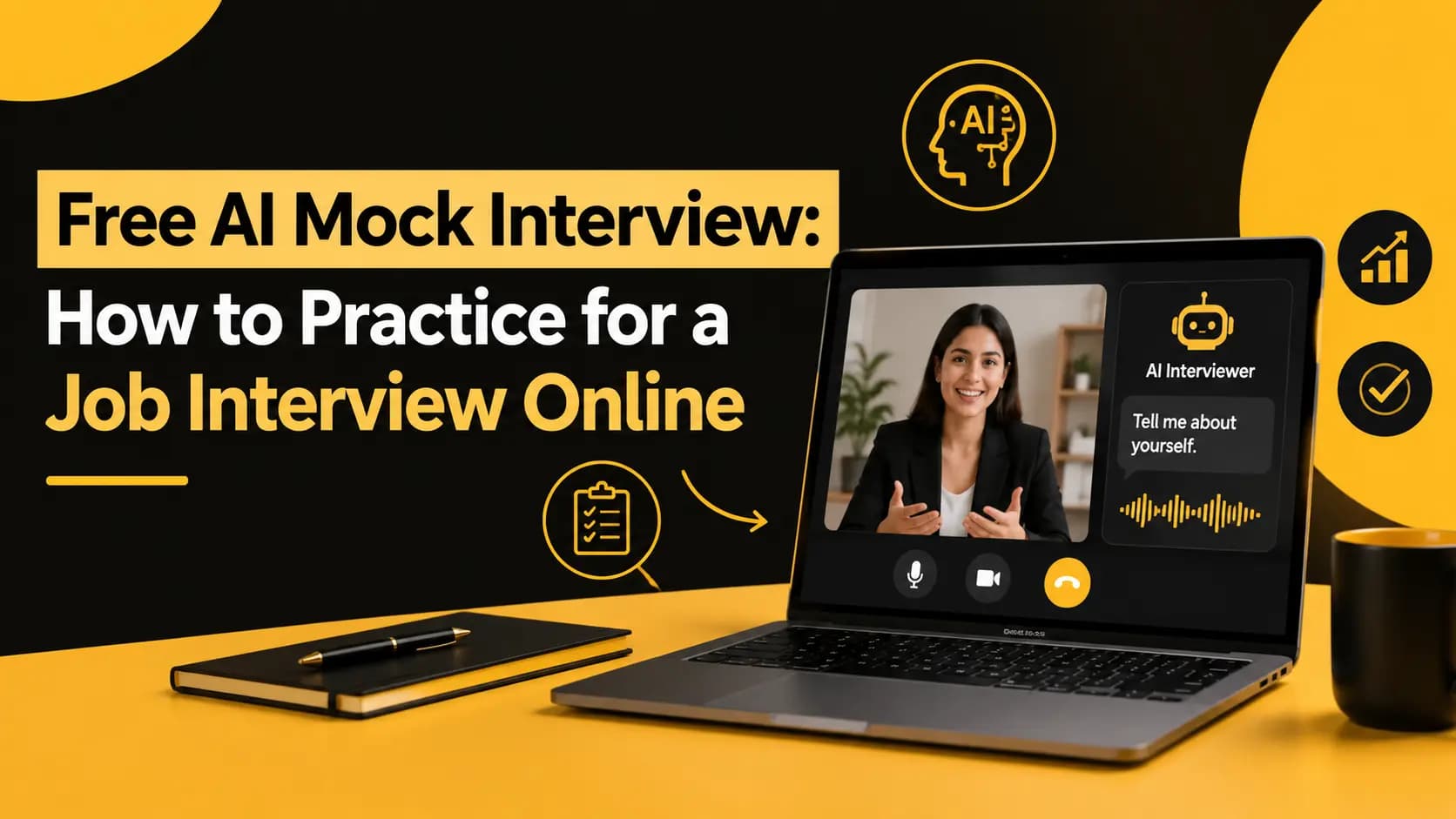
An AI interview practice tool can provide a more structured experience by helping you practice questions and review different aspects of your delivery. Instead of manually deciding what to evaluate every time, you can use feedback to identify areas that deserve attention.
The most useful approach is still the same: practice, review the feedback, choose a specific improvement, and practice again. The technology is there to make the process easier, not to replace the candidate's own preparation.
Practice Your Video Interview With VideoPitcher
If you want to practice for a video interview without depending on another person, VideoPitcher's free AI Interview Practice tool gives you a way to practice interview questions on camera.
You can use the practice experience to work on different parts of your interview delivery, including communication, confidence, speaking pace, filler words, eye contact, engagement, and answer structure.
Instead of simply wondering whether your answer was good, you can use practice and feedback to identify specific areas that you want to improve before the real interview.
The most important part is what you do with the feedback. If a practice session shows that your answers are too long, work on concise answers in the next session. If you use too many filler words, focus on pauses. If you speak too quickly, practice slowing down your delivery.
How to Get the Most From Free Video Interview Practice
A free practice tool is most useful when you treat it as part of a process rather than as a one-time test.
Use this approach:
- ✓Choose the role you are preparing for.
- ✓Practice questions relevant to that role.
- ✓Answer naturally without reading a script.
- ✓Record your response.
- ✓Review your feedback.
- ✓Choose one or two areas to improve.
- ✓Answer the same question again.
- ✓Compare your attempts.
- ✓Move to another question.
- ✓Complete a full practice interview before the real interview.
Do not worry about getting a perfect practice result immediately. The purpose of practice is to discover what you can improve while there is still time to improve it.
A One-Week Video Interview Practice Plan
If your interview is coming up soon, you can organize your preparation across several short sessions instead of trying to do everything in one day.
| Day | Focus | Practice |
|---|---|---|
| Day 1 | Baseline | Record answers to common interview questions and identify your biggest communication issues. |
| Day 2 | Answer structure | Practice concise answers and behavioral questions using STAR. |
| Day 3 | Delivery | Focus on speaking pace, pauses, filler words, and clarity. |
| Day 4 | Camera practice | Focus on eye contact, posture, facial expression, and natural delivery. |
| Day 5 | Difficult questions | Practice unexpected, behavioral, and uncomfortable questions. |
| Day 6 | Full interview | Complete a realistic mixed-question video interview. |
| Day 7 | Final review | Review your strongest and weakest areas and complete one final practice session. |
What Should You Do the Day Before a Video Interview?
The day before the interview is not the time to memorize dozens of new answers. Focus on becoming familiar with your key experiences and making sure your video setup works.
Final preparation checklist:
- ✓Review the job description.
- ✓Review your most relevant projects and achievements.
- ✓Practice your introduction.
- ✓Practice several behavioral questions.
- ✓Review difficult questions without memorizing answers.
- ✓Check your camera and microphone.
- ✓Check your lighting and background.
- ✓Confirm your internet connection.
- ✓Prepare the interview location.
- ✓Get enough rest instead of spending the entire night practicing.
How to Know When You Are Ready
Being ready does not mean that every answer is perfect. Interviews are conversations, and you cannot predict every question you will receive.
A better sign of preparation is that you can explain your experience without depending on a script, recover when you make a small mistake, organize your thoughts when asked an unexpected question, and communicate your main points clearly.
You are becoming interview-ready when you can:
- ✓Introduce yourself naturally.
- ✓Explain your relevant experience clearly.
- ✓Describe important projects without reading notes.
- ✓Answer behavioral questions using specific examples.
- ✓Explain your personal contribution to team projects.
- ✓Discuss results and measurable achievements.
- ✓Handle difficult questions without immediately losing your structure.
- ✓Maintain natural camera engagement.
- ✓Control your speaking pace.
- ✓Use fewer unnecessary filler words.
- ✓Recover naturally after making a small mistake.
Video Interview Practice Checklist
- ✓I know the exact role I am preparing for.
- ✓I have reviewed the job description.
- ✓I have selected common interview questions.
- ✓I have selected behavioral questions.
- ✓I have selected role-specific questions.
- ✓I have practiced difficult questions.
- ✓I prepare key points instead of memorizing scripts.
- ✓I answer questions aloud.
- ✓I record my answers on camera.
- ✓I review my recordings.
- ✓I check my speaking pace.
- ✓I check my filler words.
- ✓I check my eye contact.
- ✓I check my answer structure.
- ✓I check my confidence and engagement.
- ✓I repeat answers after identifying improvements.
- ✓I have completed a full mock video interview.
- ✓My camera and microphone are ready.
- ✓My interview environment is quiet and professional.
- ✓I have practiced before the actual interview instead of making the real interview my first attempt.
Conclusion: You Do Not Need a Practice Partner to Prepare
Practicing for a video interview alone is completely possible. You do not need to wait for a friend, mentor, recruiter, or career coach to become available before you start.
The most important thing is to turn preparation into an active process. Choose relevant questions, answer them out loud, record yourself, review your communication, identify a specific improvement, and answer the question again.
Do not focus only on what you say. Pay attention to how you communicate it. Speaking pace, filler words, eye contact, confidence, clarity, answer structure, pauses, and overall delivery can all affect how effectively your experience comes across in a video interview.
And remember: you do not need to become a perfect speaker. You need to become comfortable explaining your experience clearly and naturally.
If you want a structured way to practice without needing another person, try VideoPitcher's free AI Interview Practice tool. Practice interview questions on camera, review your performance, identify areas to improve, and use the next attempt to apply what you learned.
Frequently Asked Questions
How can I practice for a video interview alone?
Choose questions relevant to the job, answer them on camera, review the recording, identify one or two areas to improve, and record the answer again. Focus on communication, answer structure, speaking pace, filler words, eye contact, confidence, and clarity.
How do I practice interview questions by myself?
Prepare a list of common, behavioral, difficult, and role-specific questions. Answer each question aloud while recording yourself, then review the recording and repeat the question after making a specific improvement.
Should I record myself practicing for a video interview?
Yes. Recording yourself helps you see and hear how you actually communicate. You can review your speaking pace, filler words, eye contact, posture, answer structure, clarity, and overall delivery.
How many times should I practice a video interview?
There is no fixed number that works for everyone. A useful approach is to practice a question, review your response, identify one improvement, and answer the same question again. As the interview approaches, include complete mock interview sessions.
Should I memorize my interview answers?
It is generally better to prepare key points instead of memorizing complete answers. Key points give you structure while allowing you to adapt naturally when the interviewer asks the question differently.
How can I practice for a video interview without another person?
Use your phone or computer camera, prepare relevant interview questions, answer them aloud, record your responses, and review your performance. A free AI interview practice tool can provide a more structured experience without requiring another person.
How can VideoPitcher help me practice for a video interview alone?
VideoPitcher's free AI Interview Practice tool lets candidates practice interview questions on camera and receive structured feedback across areas such as communication, confidence, speaking pace, filler words, eye contact, engagement, and answer delivery.
What should I focus on when reviewing my video interview practice?
Review whether you answered the question directly, explained your experience clearly, used specific examples, maintained a comfortable speaking pace, avoided excessive filler words, maintained natural camera engagement, and kept your answer focused.
Can I practice a video interview on my phone?
Yes. A phone camera can be enough to practice. Position it securely at approximately eye level, make sure your face is visible, check your audio, and choose a quiet environment with minimal distractions.
What is the best way to improve after practicing an interview?
Do not try to fix everything at once. Identify one or two specific weaknesses from each practice session, apply the improvement to the same question, compare the new recording with the previous one, and then move to another question.
Scorecard — implementation checklist
- Choose the specific role you are preparing for.
- Review the job description before selecting practice questions.
- Practice common, behavioral, difficult, and role-specific questions.
- Answer questions aloud instead of only thinking about your responses.
- Record yourself answering questions on camera.
- Review your communication, speaking pace, filler words, eye contact, and answer structure.
- Identify one or two specific improvements after each recording.
- Record the same answer again and apply the feedback.
- Practice without memorizing complete scripts.
- Complete at least one realistic full video interview practice session.
Frequently asked questions
How can I practice for a video interview alone?+
Choose interview questions related to the job, answer each question on camera, review your recording, identify one or two areas to improve, and record the answer again. Focus on communication, answer structure, speaking pace, filler words, eye contact, confidence, and clarity rather than memorizing complete answers.
How do I practice interview questions by myself?+
You can practice interview questions by yourself by preparing a list of common, behavioral, and role-specific questions and answering them aloud while recording yourself. Reviewing the recordings helps you identify habits that may not be obvious while you are speaking.
Should I record myself practicing for a video interview?+
Yes. Recording yourself is one of the simplest ways to understand how you actually communicate during an interview. You can review your speaking pace, filler words, eye contact, posture, answer structure, clarity, and overall delivery.
How many times should I practice a video interview?+
There is no fixed number that works for everyone. A useful approach is to practice a question, review the response, identify one specific improvement, and answer the same question again. Repeat this process until your delivery becomes more natural rather than simply repeating the same answer without reviewing it.
Should I memorize my interview answers?+
It is generally better to prepare key points instead of memorizing complete answers. Memorized responses can sound rehearsed and may become difficult to adapt when the interviewer asks a slightly different question.
How can I practice for a video interview without another person?+
You can practice alone using your phone or computer camera, a list of interview questions, and a structured review process. A free AI interview practice tool can make the process easier by providing questions and feedback without requiring another person to conduct the practice interview.
How can VideoPitcher help me practice for a video interview alone?+
VideoPitcher's free AI Interview Practice tool lets candidates practice interview questions on camera and receive structured feedback on areas such as communication, confidence, speaking pace, filler words, eye contact, engagement, and answer delivery.
Written by VideoPitcher Editorial Team
Career & Interview Preparation Desk
Published September 18, 2026
Keywords covered
Related resources
Ready to transform your hiring process?
Start using VideoPitcher today with 20 FREE AI Video Screening Credits, plus Unlimited AI Resume Analysis and Unlimited Text Screening Assessments. No credit card is required—just start screening smarter and find the right candidates faster.