Retail Hiring Assessment: Questions, Skills Tests and Scorecards for 4 Roles
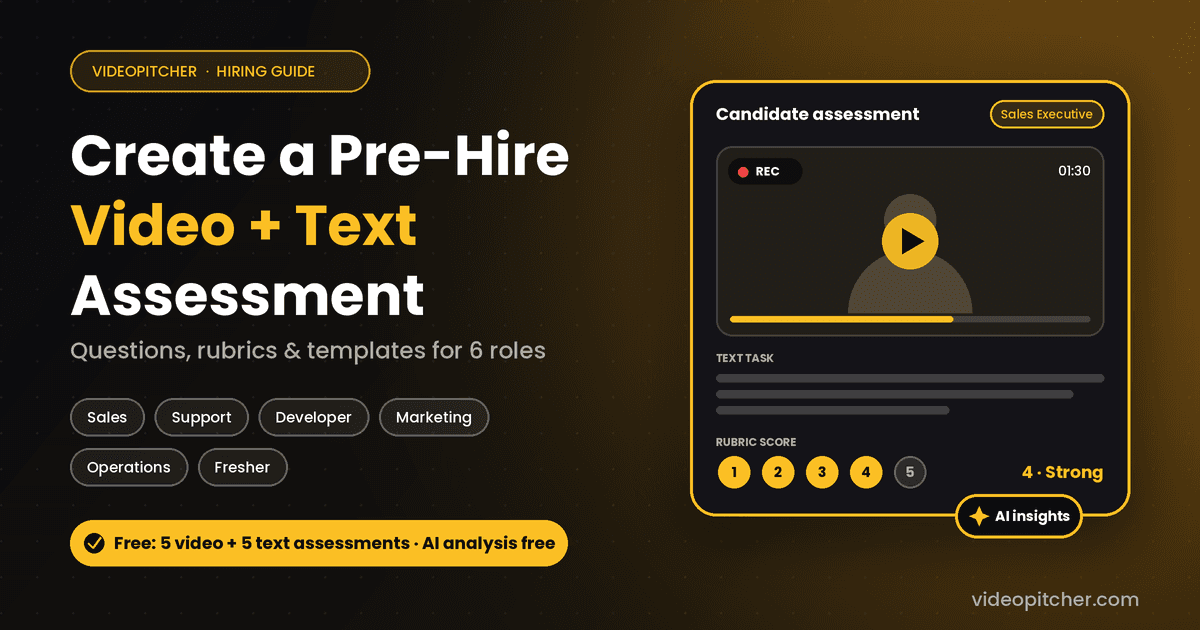
A retail hiring assessment helps employers evaluate candidates for sales associate, cashier, store supervisor and customer support positions using structured video and text questions. To create one: identify 3–5 essential competencies, write realistic retail scenarios, choose video or text tasks, create a 1–5 scoring rubric, and assign reviewers. Below is the method, a comparison table, and copy-ready templates for four common retail roles.
A retail hiring assessment is a structured evaluation used to measure whether candidates have the skills needed for retail positions. It can include video questions, written scenarios, and practical tasks that evaluate customer service, communication, sales ability, problem-solving, and teamwork. Candidates are scored against predefined criteria so hiring teams can compare responses consistently.
A retail hiring assessment is a structured way to evaluate candidates for store associate, cashier, sales assistant, and store supervisor positions before making a hiring decision. It combines role-specific interview questions, practical customer scenarios, communication assessments, and consistent scoring criteria. A good retail assessment focuses on customer service, product knowledge, problem-solving, reliability, and teamwork. Using video and text assessments helps hiring teams compare candidates more consistently while reducing repetitive first-round interviews.
Key takeaways
- ✓Evaluate customer service, communication, reliability, and problem-solving instead of relying only on previous retail experience.
- ✓Use realistic retail scenarios to understand how candidates handle customers, complaints, queues, and unexpected situations.
- ✓Combine video questions with written tasks to assess both communication and practical reasoning.
- ✓Create a consistent 1–5 scoring rubric before reviewing candidate responses.
- ✓Keep assessments short and relevant so candidates can complete them without unnecessary effort.
- ✓Use AI-generated insights as additional review support, not as a replacement for human hiring decisions.
What is a retail hiring assessment?
A retail hiring assessment is a structured evaluation process used to determine whether a candidate has the skills and behaviors needed to work successfully in a retail environment.
Retail employees interact directly with customers, manage products, process transactions, answer questions, and sometimes handle difficult situations. Their performance can influence customer satisfaction, store operations, and sales.
A traditional retail interview often focuses on previous experience and general questions such as whether someone has worked in retail before, feels comfortable working with customers, or can work flexible shifts. These questions provide useful background, but they do not always reveal how a candidate will behave during an actual customer interaction.
A structured retail hiring assessment goes further. It asks candidates to explain how they would handle realistic situations, demonstrate their communication skills, and complete practical tasks related to the position.
Why is a structured retail hiring process important?
Retail recruitment can involve a high volume of applications, particularly when businesses are hiring for multiple stores or seasonal positions. Recruiters must identify suitable candidates while managing limited time and operational requirements.
Without a structured process, hiring decisions can depend too heavily on first impressions, previous job titles, or an interviewer's personal preferences. A consistent assessment process helps solve several common challenges.
1. Identifying strong candidates beyond their resumes
A resume may show that someone worked as a sales associate for two years. However, it does not necessarily explain how they handled difficult customers, managed busy periods, or contributed to sales targets. Practical assessment questions help recruiters understand the candidate's actual experience and approach.
2. Evaluating customer service skills
Customer service is central to many retail positions. Candidates should demonstrate that they can listen to customers, understand their needs, communicate clearly, and respond professionally. Scenario-based questions provide a better opportunity to evaluate these behaviors than general questions about customer service experience.
3. Managing high-volume recruitment
When hiring for multiple stores, reviewing every applicant through individual phone calls can become time-consuming. Structured video and text assessments allow candidates to respond at their own convenience and enable hiring teams to review responses when their schedules permit.
4. Improving consistency across store locations
Different store managers may have different interviewing styles. Using the same core questions and scoring criteria helps ensure that candidates applying for the same position are evaluated against comparable expectations.
5. Reducing hiring mistakes
A candidate who performs well in a conversation may still struggle with the practical responsibilities of the role. Combining experience-based questions with realistic scenarios provides additional information before making a hiring decision.
What skills should recruiters evaluate when hiring retail staff?
Before creating an assessment, identify the competencies that are important for the specific retail position. Here are six useful areas to evaluate.
1. Customer service and empathy
Retail employees regularly interact with customers who have different expectations, questions, and concerns. Evaluate whether candidates can listen carefully, understand customer needs, and respond respectfully.
Example question: A customer is unhappy because a product they purchased is defective. How would you handle the situation?
- ✓Listening and understanding.
- ✓Empathy and patience.
- ✓Professional communication.
- ✓Ability to identify a suitable solution.
2. Communication skills
Retail employees must explain product information, answer questions, and communicate with customers and colleagues.
Example question: How would you explain the difference between two similar products to a customer who is unsure which one to purchase?
- ✓Clarity of explanation.
- ✓Ability to understand customer requirements.
- ✓Confidence without unnecessary pressure.
- ✓Ability to communicate product information.
3. Problem-solving abilities
Unexpected situations are common in retail environments. An employee may need to manage a billing issue, locate missing inventory, handle a customer complaint, or resolve a scheduling problem.
Example question: A customer wants to purchase an item, but the store's inventory system shows that it is unavailable. What would you do?
- ✓Logical thinking.
- ✓Understanding of store procedures.
- ✓Ability to suggest alternatives.
- ✓Ownership of the situation.
4. Sales and product knowledge
Retail employees often need to understand products and recommend suitable options.
Example question: A customer enters your store looking for a product but is unsure what they need. How would you help them choose?
- ✓Understanding customer requirements.
- ✓Product recommendation skills.
- ✓Ability to explain benefits.
- ✓Ethical selling practices.
5. Reliability and time management
Retail stores depend on employees arriving on time, following schedules, and completing assigned responsibilities.
Example question: You have several tasks to complete before the store opens, but there is limited time. How would you prioritize them?
- ✓Prioritization.
- ✓Responsibility.
- ✓Awareness of deadlines.
- ✓Ability to organize work.
6. Teamwork and adaptability
Retail employees work with store managers, cashiers, inventory teams, and other associates.
Example question: Describe a situation where you helped a colleague during a particularly busy work period.
- ✓Collaboration.
- ✓Flexibility.
- ✓Communication with colleagues.
- ✓Willingness to support the team.
What are the best retail interview questions to ask candidates?
The following questions can be used in video interviews, written assessments, or structured hiring conversations.
| Competency | Interview question | Assessment format |
|---|---|---|
| Customer service | How would you handle an unhappy customer? | Video |
| Communication | How would you explain a product to a first-time customer? | Video |
| Problem-solving | What would you do if a customer requested an unavailable product? | Video or text |
| Sales ability | How would you recommend an additional product without pressuring a customer? | Video |
| Time management | How would you prioritize five tasks during a busy shift? | Text |
| Teamwork | Describe a time you supported a colleague. | Video |
| Reliability | What would you do if you realized you might arrive late for your shift? | Text |
The questions should be adjusted to the responsibilities of the position. For example, a cashier assessment should emphasize transaction accuracy and customer interactions, while a store supervisor assessment should include team coordination and operational decision-making.
How do you create a retail hiring assessment in 5 steps?
Creating an effective assessment does not require a complicated testing process. Follow these five steps.
Step 1: Define the skills required for the position
Start by reviewing the actual responsibilities of the job. A retail sales associate may require customer service, communication, product knowledge, and sales skills. A cashier may require transaction accuracy, attention to detail, and customer interaction skills. A store supervisor may need leadership, problem-solving, and team management abilities.
Choose three to five essential competencies for the assessment. Focusing on the most important skills makes the assessment easier to complete and the results easier to evaluate.
Step 2: Select video and text questions
Choose the assessment format based on the skill you want to evaluate. Use video questions when communication, customer interaction, and explanation are important. Use text tasks when you want to evaluate written communication, prioritization, and structured reasoning.
Most retail positions can benefit from a combination of both formats.
Step 3: Create realistic retail scenarios
Avoid relying entirely on generic interview questions. Use situations that employees are likely to encounter during their daily work.
- ✓An unhappy customer requests a refund.
- ✓A customer cannot find a product.
- ✓Multiple customers need assistance simultaneously.
- ✓A billing error occurs during checkout.
- ✓A colleague needs help during a busy shift.
Realistic questions help recruiters understand how candidates approach situations relevant to the job.
Step 4: Create a scoring rubric
Before reviewing candidates, define how responses will be evaluated. A simple five-point scale can help reviewers compare responses consistently.
| Score | Rating | Evaluation |
|---|---|---|
| 1 | Poor | Cannot provide a relevant response or practical solution. |
| 2 | Below expectations | Understands part of the situation but misses important details. |
| 3 | Meets expectations | Provides a reasonable response with a practical approach. |
| 4 | Strong | Gives a clear, structured response and considers customer needs. |
| 5 | Excellent | Demonstrates strong judgment, ownership, and an effective solution. |
Create specific behavioral examples for each competency rather than relying entirely on these general descriptions.
Step 5: Review and compare candidates
Have reviewers evaluate candidate responses using the same criteria. Where possible, ask reviewers to score independently before discussing their observations. Compare the evidence, identify strengths and weaknesses, and decide which candidates should move to the next hiring stage.
For more guidance on shared scorecards and reviewer responsibilities, see our collaborative assessment guide.
What do retail hiring assessment templates look like for 4 common positions?
Copy these templates, then adapt them to your company's products, customers, store policies, and job responsibilities. Each template includes two video questions, one text task, and scoring anchors for a 1, 3, and 5.
1. Retail Sales Associate
Competencies: Customer service · Communication · Product knowledge · Sales ability
Video questions: A customer enters the store but is unsure what product they need. How would you help them? Tell us about a time you convinced someone to consider a product or service. Text task: A customer is interested in purchasing a product but believes the price is too high. Write a short response explaining its value without pressuring the customer.
| Score | Anchor |
|---|---|
| 1 | Gives generic answers and does not consider customer needs. |
| 3 | Explains product benefits and responds politely. |
| 5 | Identifies customer needs, communicates relevant benefits, and makes an appropriate recommendation. |
2. Cashier
Competencies: Accuracy · Attention to detail · Customer service · Responsibility
Video questions: How would you handle a customer who believes they were charged incorrectly? What would you do if you noticed a discrepancy in your cash register? Text task: A customer is waiting in a queue and claims that they were charged twice for one product. Explain the steps you would take to investigate and resolve the issue.
| Score | Anchor |
|---|---|
| 1 | Does not explain a clear process or ignores the customer's concern. |
| 3 | Checks the transaction and follows the appropriate procedure. |
| 5 | Remains professional, verifies the transaction, follows store policy, and communicates the resolution clearly. |
3. Store Supervisor
Competencies: Leadership · Prioritization · Problem-solving · Team management
Video questions: How would you manage your team when the store becomes unexpectedly busy? Describe a situation where you had to resolve a disagreement between team members. Text task: Three employees are unavailable during a busy shopping period. Explain how you would reorganize responsibilities to maintain store operations.
| Score | Anchor |
|---|---|
| 1 | Provides no clear plan for managing the situation. |
| 3 | Reassigns responsibilities and prioritizes important tasks. |
| 5 | Evaluates staffing needs, communicates priorities, manages risks, and maintains customer service. |
4. Customer Support Representative for Retail
Competencies: Empathy · Written communication · Problem-solving · Ownership
Video questions: How would you respond to a customer who is angry because their online order has not arrived? Describe how you would explain a refund policy to a customer who disagrees with it. Text task: Write a response to a customer whose delivery is delayed. Acknowledge their concern, explain the next steps, and provide a professional response.
| Score | Anchor |
|---|---|
| 1 | Gives an unclear or defensive response. |
| 3 | Responds politely and provides basic information. |
| 5 | Acknowledges the concern, communicates clearly, takes ownership, and explains practical next steps. |
Should retail recruiters use video or text assessments?
Both formats provide useful but different information. Use video when communication and customer interaction are important, and text when written communication and structured reasoning need to be evaluated.
| Evaluation area | Video assessment | Text assessment |
|---|---|---|
| Communication | Demonstrates verbal explanation | Demonstrates written clarity |
| Customer interaction | Evaluates responses to customer scenarios | Evaluates written customer replies |
| Problem-solving | Allows candidates to explain their approach | Shows structured written reasoning |
| Time management | Allows verbal explanation of priorities | Allows written prioritization |
| Best suited for | Sales associates, supervisors, customer-facing roles | Cashiers, customer support, operational tasks |
For most customer-facing retail positions, video responses can provide useful evidence of how candidates explain situations. Text tasks are particularly useful for evaluating written communication and the ability to organize information.
A combined assessment can help recruiters evaluate multiple job-related competencies without depending on a single interview format. Learn more about how a combined video and text assessment works in our guide to modern hiring.
How can AI help recruiters evaluate retail candidates?
Reviewing large numbers of candidate responses can take considerable time. AI-assisted hiring tools can help organize candidate information and provide additional insights during the initial evaluation process.
- ✓Resume analysis: Help recruiters review relevant experience and qualifications.
- ✓Video response insights: Provide additional information about candidate responses and communication-related signals.
- ✓Text response analysis: Help organize and review written answers.
- ✓Candidate comparison: Support a more organized review of multiple applicants.
- ✓Team collaboration: Give hiring teams a shared workflow for reviewing and discussing candidates.
However, AI should support the recruitment process rather than make the final hiring decision. Recruiters should review original candidate responses, verify relevant evidence, and apply consistent job-related criteria.
Our guide to AI resume screening explains how resume analysis and assessment insights can support a more organized candidate review process.
How do you run retail hiring assessments using VideoPitcher?
VideoPitcher helps recruitment teams create structured video and text assessments for different job positions. Instead of conducting an individual first-round phone interview with every applicant, recruiters can collect candidate responses through a structured assessment workflow.
- ✓Create your company workspace on VideoPitcher and set up your hiring requirements.
- ✓Create a retail job listing and add questions based on the position.
- ✓Share the assessment link with candidates so they can apply with their resumes and complete the video or text assessment through their browser on mobile or desktop.
- ✓Review the AI analysis of candidate resumes and assessment responses to get additional hiring insights.
- ✓Invite teammates to review and rate candidate responses, compare feedback, and shortlist applicants for the next stage.
For example, a sales associate assessment could include two video questions about customer interactions and one text task about product recommendations. A cashier assessment could focus on transaction accuracy, customer communication, and resolving billing issues.
| Plan | What you get |
|---|---|
| Free, forever | 5 video assessment credits + 5 text assessment credits. AI analysis is free. |
| Pay as you go (India) | ₹25 per assessment. |
| Pay as you go (international) | $0.5 per assessment. |
| Enterprise | Available for larger teams and custom needs. Contact VideoPitcher. |
For example, if a retail business assesses 40 candidates in India, the cost at ₹25 per assessment is ₹1,000 before applying free credits. Check the pricing page for how your specific assessment format is counted.
VideoPitcher is designed for SMBs, startups, staffing agencies, and mid-market teams that want video and text assessments with AI analysis in one affordable workflow. Businesses with deeply established ATS ecosystems and extensive enterprise compliance requirements may prefer broader recruitment suites.
What are the most common mistakes in retail hiring assessments?
- ✓Asking only general questions. Questions such as 'Are you good with customers?' do not provide much evidence. Use practical customer scenarios instead.
- ✓Ignoring communication skills. Retail employees regularly interact with customers. Include questions that evaluate clear, professional communication.
- ✓Making assessments too long. Keep the assessment focused on essential competencies and avoid unnecessary questions.
- ✓Evaluating every position using the same criteria. A cashier and a store supervisor have different responsibilities. Customize assessments according to each role.
- ✓Relying entirely on AI scores. AI-generated insights should be reviewed alongside candidate responses and human evaluations.
- ✓Not testing the assessment before launch. Run a small pilot to identify confusing questions, unclear instructions, and scoring inconsistencies.
How can retail businesses make their hiring process fairer?
A fair hiring process should give candidates comparable opportunities to demonstrate the skills required for the position. A structured assessment can improve consistency, but it does not automatically eliminate bias.
- ✓Ask candidates applying for the same position the same core questions.
- ✓Use clearly defined scoring criteria.
- ✓Evaluate job-related behaviors rather than personal preferences.
- ✓Provide clear instructions and reasonable time limits.
- ✓Consider accessibility needs and alternative assessment formats where appropriate.
- ✓Keep candidate information confidential and follow applicable data protection requirements.
- ✓Ensure hiring decisions remain with qualified human reviewers.
Regularly review your questions and scoring process to identify assumptions that could disadvantage candidates. This article is not legal advice; confirm applicable candidate data and privacy requirements with your legal or HR counsel.
Frequently asked questions
What is a retail hiring assessment? A retail hiring assessment is a structured evaluation used to measure the skills required for retail positions, including customer service, communication, sales, problem-solving, reliability, and teamwork.
What skills should recruiters evaluate when hiring retail staff? Recruiters should evaluate customer service, communication, product knowledge, sales ability, problem-solving, reliability, and teamwork. The exact competencies depend on the position.
How many questions should a retail hiring assessment include? Three to five focused questions are a practical starting point. A combination of two short video questions and one written task can evaluate several important competencies without making the process unnecessarily long.
Are video assessments useful for retail recruitment? Yes. Video assessments allow candidates to explain how they would handle customer interactions, product recommendations, and difficult situations. They provide additional context beyond a resume.
Can freshers complete retail hiring assessments? Yes. Assessments can be designed around realistic workplace scenarios rather than requiring previous retail experience. This allows recruiters to evaluate transferable skills, communication, and problem-solving abilities.
How can recruiters compare retail candidates fairly? Use the same core questions, structured scoring rubrics, and job-related evaluation criteria for candidates applying to the same role. Reviewers should record evidence before making a recommendation.
Can AI help with retail candidate screening? AI-assisted tools can help analyze resumes and assessment responses and provide additional insights. Recruiters should verify these insights and retain responsibility for hiring decisions.
Is VideoPitcher suitable for retail recruitment? VideoPitcher supports structured video and text assessments, resume analysis, AI-generated insights, and collaborative candidate review. Retail businesses can customize assessments around the requirements of different store positions.
How much does VideoPitcher cost? VideoPitcher provides 5 video and 5 text assessment credits free forever, with free AI analysis. Beyond the free credits, pricing is ₹25 per assessment in India and $0.5 per assessment internationally. Enterprise options are available for larger hiring requirements.
Start building better retail hiring assessments
Hiring the right retail employees requires more than reviewing resumes and asking general interview questions. A structured assessment helps recruiters understand how candidates communicate, solve problems, assist customers, and respond to realistic workplace situations.
By combining video questions, written tasks, consistent scoring criteria, and AI-assisted insights, businesses can create a more organized recruitment process.
VideoPitcher makes it easier to create role-specific assessments, collect candidate responses, and collaborate with your hiring team.
Start building your first assessment with VideoPitcher →
Scorecard — implementation checklist
Frequently asked questions
What is a retail hiring assessment?+
A retail hiring assessment is a structured evaluation used to measure the skills required for retail positions, including customer service, communication, sales, problem-solving, reliability, and teamwork.
What skills should recruiters evaluate when hiring retail staff?+
Recruiters should evaluate customer service, communication, product knowledge, sales ability, problem-solving, reliability, and teamwork. The exact competencies depend on the position.
How many questions should a retail hiring assessment include?+
Three to five focused questions are a practical starting point. A combination of two short video questions and one written task can evaluate several important competencies without making the process unnecessarily long.
Are video assessments useful for retail recruitment?+
Yes. Video assessments allow candidates to explain how they would handle customer interactions, product recommendations, and difficult situations. They provide additional context beyond a resume.
Can freshers complete retail hiring assessments?+
Yes. Assessments can be designed around realistic workplace scenarios rather than requiring previous retail experience. This allows recruiters to evaluate transferable skills, communication, and problem-solving abilities.
How can recruiters compare retail candidates fairly?+
Use the same core questions, structured scoring rubrics, and job-related evaluation criteria for candidates applying to the same role. Reviewers should record evidence before making a recommendation.
Can AI help with retail candidate screening?+
AI-assisted tools can help analyze resumes and assessment responses and provide additional insights. Recruiters should verify these insights and retain responsibility for hiring decisions.
Is VideoPitcher suitable for retail recruitment?+
VideoPitcher supports structured video and text assessments, resume analysis, AI-generated insights, and collaborative candidate review. Retail businesses can customize assessments around the requirements of different store positions.
How much does VideoPitcher cost?+
VideoPitcher provides 5 video and 5 text assessment credits free forever, with free AI analysis. Beyond the free credits, pricing is ₹25 per assessment in India and $0.5 per assessment internationally. Enterprise options are available for larger hiring requirements.
Keywords covered
Related resources
Ready to transform your hiring process?
Start using VideoPitcher to collect and review candidate assessments with your team.