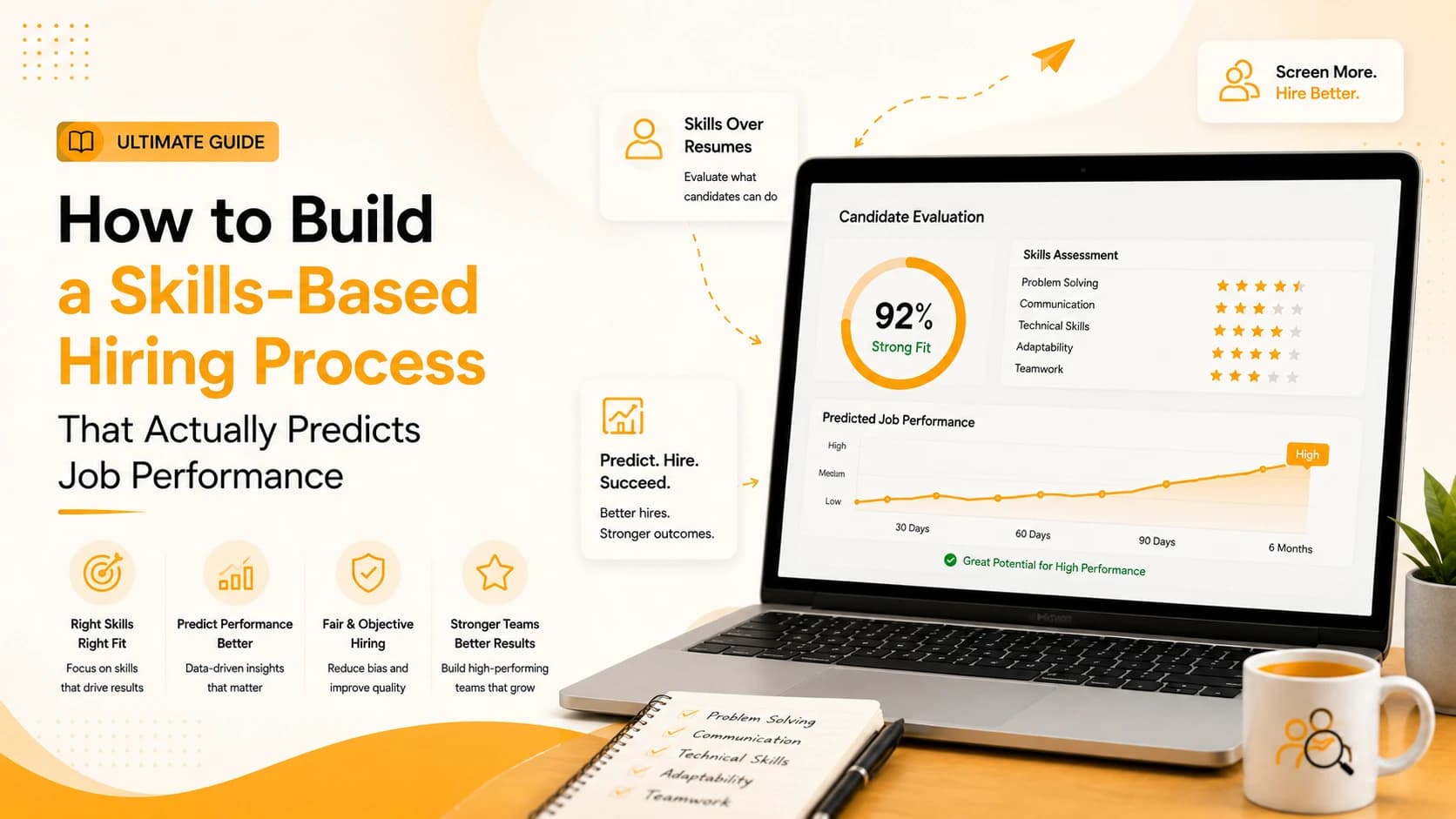
How to Measure Candidate Communication Skills During Recruitment
Learn how to measure candidate communication skills during recruitment using structured questions, video assessments, practical exercises, and consistent evaluation criteria.
Candidate communication skills can be measured during recruitment by combining structured behavioral questions, asynchronous video responses, role-specific communication exercises, and standardized scoring criteria. Instead of relying on general impressions or interview chemistry, hiring teams should evaluate how clearly candidates organize ideas, explain complex information, listen and respond appropriately, adapt their communication to different audiences, and support their answers with relevant examples. Using the same questions and evaluation rubric for every candidate makes communication assessment more consistent, comparable, and evidence-based.
Communication skills are among the most important capabilities employers evaluate during recruitment, but they are also some of the easiest to assess incorrectly. A candidate may sound confident in a conversation without being able to explain complex ideas clearly, listen carefully, adapt their message to different audiences, or communicate effectively under realistic working conditions.
The challenge for hiring teams is therefore not simply identifying candidates who communicate well. It is creating a recruitment process that produces reliable evidence of how candidates communicate. By combining structured questions, practical communication exercises, asynchronous video assessments, and consistent scoring criteria, recruiters can evaluate communication skills more objectively and make better-informed hiring decisions before moving candidates into later interview stages.
Key Takeaways
- ✓Communication skills should be evaluated through observable evidence rather than general impressions.
- ✓The most useful assessments measure clarity, structure, listening, audience awareness, conciseness, and adaptability.
- ✓Structured behavioral questions help recruiters compare how candidates handled real communication challenges.
- ✓Practical exercises reveal how candidates communicate when asked to perform realistic job-related tasks.
- ✓Asynchronous video screening allows every candidate to answer the same communication-focused questions.
- ✓A standardized scorecard makes communication evaluations more consistent across recruiters and hiring managers.
- ✓Tracking post-hire performance can reveal which communication indicators actually predict success in the role.
Why Communication Skills Are Difficult to Measure During Recruitment
Communication is one of the most frequently mentioned requirements in job descriptions, yet it is often one of the least precisely defined. A hiring manager may say that they want someone with 'excellent communication skills,' but that phrase can mean very different things depending on the role. A sales representative may need persuasive verbal communication, while a software engineer may need to explain technical concepts clearly to non-technical stakeholders.
Another challenge is that strong communication is not simply about speaking confidently. A candidate can be articulate and still struggle to listen, answer questions directly, simplify complex information, or adapt their message to the person they are speaking with. Conversely, someone who is less naturally charismatic may communicate extremely well in practical workplace situations.
This is why communication should be treated as a collection of observable behaviors rather than a personality trait. The goal of recruitment is not to identify the most impressive speaker in the room. It is to determine whether the candidate can communicate effectively in the situations they will actually encounter on the job.
What Are Candidate Communication Skills?
Candidate communication skills include the ability to express ideas clearly, understand information accurately, organize thoughts, listen actively, ask useful questions, adapt messages to different audiences, and communicate appropriately in professional situations. Depending on the position, communication may include verbal, written, interpersonal, presentation, negotiation, and customer-facing skills.
For recruitment purposes, it is useful to break communication into measurable competencies. This makes it easier to create relevant interview questions and scoring criteria rather than asking reviewers to decide whether a candidate simply 'communicates well.'
Communication competencies commonly worth assessing:
- ✓Clarity – Can the candidate express an idea in a way that is easy to understand?
- ✓Structure – Can they organize information logically instead of jumping between unrelated points?
- ✓Conciseness – Can they communicate the important information without unnecessary detail?
- ✓Active listening – Do they understand the question before responding and address what was actually asked?
- ✓Audience awareness – Can they adjust their language and level of detail depending on who they are speaking to?
- ✓Adaptability – Can they change their communication approach when a situation or audience changes?
- ✓Empathy – Can they recognize another person's perspective and respond appropriately?
- ✓Questioning – Can they ask relevant questions to clarify needs, requirements, or problems?
- ✓Written communication – Can they communicate clearly through email, documentation, messages, or other written formats?
Step 1: Define What Good Communication Looks Like for the Role
The first step in measuring communication skills is defining what effective communication actually means for the position. Avoid using a generic requirement such as 'excellent communication skills.' Instead, connect communication behaviors to the responsibilities of the role.
For example, a customer success manager may need to explain product limitations without creating unnecessary friction. A sales representative may need to ask effective discovery questions and communicate value clearly. A technical lead may need to translate complex technical decisions into language that business stakeholders can understand.
Once the role-specific requirements are clear, recruiters can build questions and exercises that directly test those capabilities.
Questions to ask when defining communication requirements:
- ✓Who will this person communicate with most frequently?
- ✓Will communication primarily be verbal, written, visual, or a combination?
- ✓Does the role require explaining complex information to non-specialists?
- ✓Does the employee need to persuade, negotiate, teach, sell, support, or influence others?
- ✓What communication mistakes would create the greatest problems in the role?
- ✓Which communication behaviors separate high performers from average performers?
Step 2: Use Structured Behavioral Questions
Behavioral interview questions are one of the most practical ways to evaluate communication because they ask candidates to provide evidence from real situations. Instead of asking, 'Are you a good communicator?' ask candidates to describe a specific situation where communication affected an outcome.
The quality of the answer provides evidence about more than the candidate's communication style. It can show whether they can structure a story, distinguish important details from unnecessary information, explain their own contribution, and connect communication choices to measurable outcomes.
Examples of Communication Skills Interview Questions
Useful questions for assessing candidate communication:
- ✓Tell me about a time you had to explain a complex idea to someone without your level of expertise. How did you approach it?
- ✓Describe a situation where a colleague or customer misunderstood you. What did you do to resolve the misunderstanding?
- ✓Tell me about a time you had to communicate difficult or negative information to someone. How did you handle it?
- ✓Describe a situation where you had to adapt your communication style for a different audience.
- ✓Tell me about a time when asking the right question helped you understand or solve a problem.
- ✓Describe a presentation, meeting, or conversation that did not go as planned. What did you change?
Listen for specific evidence rather than polished language alone. Strong candidates typically explain the context, describe their communication choices, identify what they did personally, and explain the outcome. Weak answers often stay at the level of general statements such as 'I always communicate openly' without providing a concrete example.
Step 3: Assess Communication Through Practical Exercises
Interview questions tell you how candidates describe their communication abilities. Practical exercises show you how they actually communicate. For roles where communication has a meaningful impact on performance, this distinction can be extremely valuable.
A practical exercise does not need to be complicated. The best exercises recreate a small but representative part of the actual job. A customer support candidate might respond to an unhappy customer. A sales candidate might explain a product to a fictional prospect. A manager might deliver difficult feedback to a team member. A technical candidate might explain a technical decision to a non-technical stakeholder.
Examples of Communication Exercises
| Role | Example Exercise | Communication Skills Measured |
|---|---|---|
| Sales Representative | Explain a product to a prospect who has a specific objection. | Persuasion, listening, questioning, clarity, objection handling |
| Customer Support | Respond to a customer describing a frustrating problem. | Empathy, clarity, de-escalation, problem explanation |
| Software Engineer | Explain a technical decision to a non-technical stakeholder. | Simplification, structure, audience awareness |
| Marketing Manager | Present a campaign idea to a fictional executive. | Storytelling, persuasion, concise communication |
| People Manager | Deliver constructive feedback in a simulated conversation. | Empathy, clarity, listening, difficult conversations |
Step 4: Use Asynchronous Video to Measure Verbal Communication
Asynchronous video screening can be especially useful when verbal communication is an important part of the job. Instead of scheduling a live call with every applicant, recruiters can provide the same questions to candidates and ask them to submit recorded responses.
This creates a consistent assessment environment. Every candidate receives the same prompt, has an opportunity to prepare, and can be evaluated using the same communication criteria. Hiring teams can also revisit responses later instead of relying on notes or memory from a live conversation.
Platforms like VideoPitcher allow recruiters to create structured video and text assessments, send candidates assessment links, collect responses, and share submissions with hiring teams. This can help move communication evaluation earlier in the recruitment funnel before investing significant time in live interviews.
Step 5: Create a Communication Skills Scorecard
A communication scorecard turns a subjective judgment into a structured evaluation. Instead of asking reviewers whether they liked a candidate's communication, define the specific behaviors they should look for and assign a consistent rating.
A simple five-point scale can work well, provided each level has a clear meaning. Reviewers should be able to look at a response and explain why they assigned a particular score using observable evidence.
| Communication Competency | Strong Evidence | Weak Evidence |
|---|---|---|
| Clarity | Explains ideas directly using language appropriate for the audience. | Uses vague or confusing explanations that require repeated clarification. |
| Structure | Presents information in a logical sequence with a clear beginning, middle, and conclusion. | Jumps between ideas without a clear structure. |
| Conciseness | Provides enough context while staying focused on the question. | Includes excessive detail or avoids answering the central question. |
| Audience Awareness | Adjusts terminology, examples, and level of detail to the listener. | Uses the same communication approach regardless of audience. |
| Active Listening | Answers the actual question and responds appropriately to new information. | Provides a prepared answer without addressing the question. |
| Empathy | Acknowledges another person's concerns before explaining the solution. | Focuses only on the task or solution without considering the other person's perspective. |
Ask reviewers to include a short evidence note with every score. For example, instead of writing 'good communicator,' a reviewer might write, 'Explained the technical concept using a simple customer example and avoided unnecessary terminology.' Evidence-based notes make evaluations easier to compare and discuss.
Step 6: Measure Communication Across Multiple Stages
Communication should not necessarily be measured through one interview question. A stronger recruitment process evaluates the competency at multiple stages using different types of evidence.
A practical communication assessment funnel:
- ✓Stage 1 – Application: Review written responses, cover letters, or application questions when writing is relevant to the position.
- ✓Stage 2 – Asynchronous assessment: Ask candidates to answer communication-focused video or text questions using a standardized rubric.
- ✓Stage 3 – Structured interview: Ask behavioral questions that explore how candidates handled real communication challenges.
- ✓Stage 4 – Practical exercise: Give finalists a realistic communication scenario connected to the actual role.
- ✓Stage 5 – Final evaluation: Combine evidence from each stage and compare candidates using the same communication criteria.
What Not to Measure When Evaluating Communication Skills
One of the biggest risks in communication assessment is confusing communication effectiveness with presentation style or personal preference. Hiring teams should be careful not to reward candidates simply because they sound familiar, use a particular accent, have a certain personality, or appear highly polished on camera.
The assessment should focus on job-relevant communication behaviors. If the role requires explaining complex ideas clearly, measure explanation ability. If it requires customer interaction, measure listening, empathy, questioning, and clarity. If it requires written communication, evaluate writing directly.
Avoid scoring candidates based on:
- ✓Accent or pronunciation differences that do not affect job performance.
- ✓Personality similarity to the interviewer.
- ✓Camera quality, expensive equipment, or production quality.
- ✓Whether the candidate uses the interviewer's preferred communication style.
- ✓Charisma when charisma is not a core requirement of the role.
- ✓Eye contact or body language when those factors are not directly relevant to job performance.
- ✓Unrelated appearance-based judgments.
Common Mistakes When Assessing Candidate Communication
Avoid these common communication assessment mistakes:
- ✓Asking candidates whether they consider themselves good communicators instead of asking for evidence.
- ✓Using different questions for every candidate, making comparisons unreliable.
- ✓Evaluating confidence instead of communication effectiveness.
- ✓Allowing interviewer chemistry to influence communication scores.
- ✓Using vague criteria such as 'professional communication' without defining observable behaviors.
- ✓Overweighting one response instead of looking across multiple assessment stages.
- ✓Ignoring written communication when the role depends heavily on email, documentation, or messaging.
- ✓Failing to train reviewers on how to apply the communication scorecard consistently.
How to Improve the Accuracy of Communication Skills Assessment
A communication assessment becomes more useful when it is designed around the actual requirements of the job. Start with the communication situations employees encounter most frequently, then create questions and exercises that reproduce those situations as closely as practical.
Use multiple evidence sources whenever communication is a major job requirement. A candidate's behavioral interview answer may show how they think about communication, while a practical exercise shows how they perform. A written assessment can reveal whether they can communicate effectively without relying on real-time conversation.
It is also important to review the assessment itself. If candidates who receive high communication scores consistently struggle after joining, the problem may not be the candidates—it may be the way communication is being measured.
How to Validate Whether Communication Scores Predict Job Performance
The strongest recruitment teams do not stop measuring at the point of hire. They use post-hire performance data to determine whether their assessment criteria actually predict success.
For example, if customer-facing employees with high communication scores consistently achieve stronger customer satisfaction results, that provides evidence that the assessment is measuring something meaningful. If there is little relationship between assessment scores and later performance, the evaluation criteria may need to be redesigned.
Track these signals after hiring:
- ✓Manager evaluations of communication effectiveness.
- ✓Customer satisfaction or customer-facing performance metrics.
- ✓Quality of written work and documentation.
- ✓Presentation or stakeholder feedback.
- ✓Collaboration and cross-functional effectiveness.
- ✓Resolution rates for communication-sensitive situations.
- ✓90-day, six-month, and annual performance outcomes.
How VideoPitcher Supports Communication Skills Assessment
VideoPitcher helps hiring teams move communication assessment earlier in the recruitment process. Recruiters can create structured video and text assessments, define role-specific questions, send candidates assessment links, collect responses asynchronously, and share candidate submissions with hiring managers.
This approach gives hiring teams a consistent set of candidate responses to review. Instead of relying entirely on resume language or a short live conversation, recruiters can evaluate how candidates actually explain ideas, structure responses, respond to role-specific scenarios, and communicate with a professional audience.
For teams hiring at scale, structured video screening can also reduce the amount of time spent conducting repetitive first-round conversations while giving hiring managers access to the same candidate evidence before deciding who should advance.
Ready to evaluate candidate communication before the live interview? Explore VideoPitcher and build structured video assessments for your hiring process.
Conclusion
Measuring candidate communication skills effectively requires more than listening for confidence during an interview. Hiring teams need to define the communication behaviors that matter for the role, create structured questions and realistic exercises, and evaluate candidates against consistent criteria.
The most reliable approach combines multiple forms of evidence: behavioral interview responses, practical communication exercises, written assessments where relevant, and structured video screening. When every candidate is evaluated against the same job-relevant standards, hiring teams can make communication assessment more consistent and less dependent on subjective impressions.
Most importantly, communication assessment should continue to evolve. By comparing pre-hire scores with post-hire performance, organizations can identify which communication behaviors actually predict success and continuously improve their recruitment process.
Scorecard — implementation checklist
- Define the specific communication behaviors required for the role.
- Separate essential communication skills from skills that can be developed after hiring.
- Use structured questions that ask candidates for specific real-world examples.
- Include practical communication exercises that reflect actual job situations.
- Use asynchronous video assessments when verbal communication is important to the role.
- Evaluate every candidate against the same communication criteria.
- Score observable evidence instead of confidence, charisma, accent, or personal similarity.
- Require reviewers to record evidence supporting their scores.
- Combine communication assessment results with other job-relevant competencies.
- Compare pre-hire communication scores with post-hire performance to improve the assessment process.
Frequently asked questions
How do you measure candidate communication skills during recruitment?+
Candidate communication skills can be measured through structured behavioral questions, role-specific communication exercises, written assessments, asynchronous video responses, and standardized interview scorecards. Recruiters should evaluate specific behaviors such as clarity, organization, listening, audience awareness, conciseness, confidence, and the ability to explain ideas with relevant examples rather than relying on general impressions.
What communication skills should recruiters assess?+
Recruiters should assess the communication capabilities that are most relevant to the role. Common areas include verbal clarity, active listening, organization of ideas, concise communication, audience awareness, empathy, questioning ability, storytelling, written communication, and the ability to explain complex information in a simple way.
What are good interview questions for assessing communication skills?+
Effective questions ask candidates to describe real situations where communication mattered. Examples include asking about a time they explained a complex concept to someone unfamiliar with the subject, handled a difficult conversation, adapted their communication style for a different audience, or resolved a misunderstanding with a colleague or customer.
Can video interviews measure communication skills accurately?+
Video interviews can provide useful evidence of verbal communication, organization, explanation ability, and professional presentation when candidates are evaluated using consistent questions and predefined criteria. Asynchronous video assessments are particularly useful because every candidate can respond to the same prompts and hiring teams can review responses consistently.
How should communication skills be scored during an interview?+
Communication skills should be scored against predefined criteria rather than overall impressions. A scorecard can evaluate areas such as clarity, structure, relevance, conciseness, audience awareness, listening, and use of examples. Each criterion should have clear descriptions of what strong, acceptable, and weak evidence looks like.
How does VideoPitcher help assess candidate communication skills?+
VideoPitcher helps hiring teams create structured video and text assessments, send candidates standardized questions, collect recorded responses, and review submissions collaboratively. Recruiters can use the same communication-focused questions and evaluation criteria for every candidate, making it easier to compare responses before scheduling live interviews.
Written by VideoPitcher Editorial Team
Talent Acquisition & HR Technology Desk
Published September 3, 2026
Keywords covered
Related resources
Ready to transform your hiring process?
Start using VideoPitcher today with 20 FREE AI Video Screening Credits, plus Unlimited AI Resume Analysis and Unlimited Text Screening Assessments. No credit card is required—just start screening smarter and find the right candidates faster.