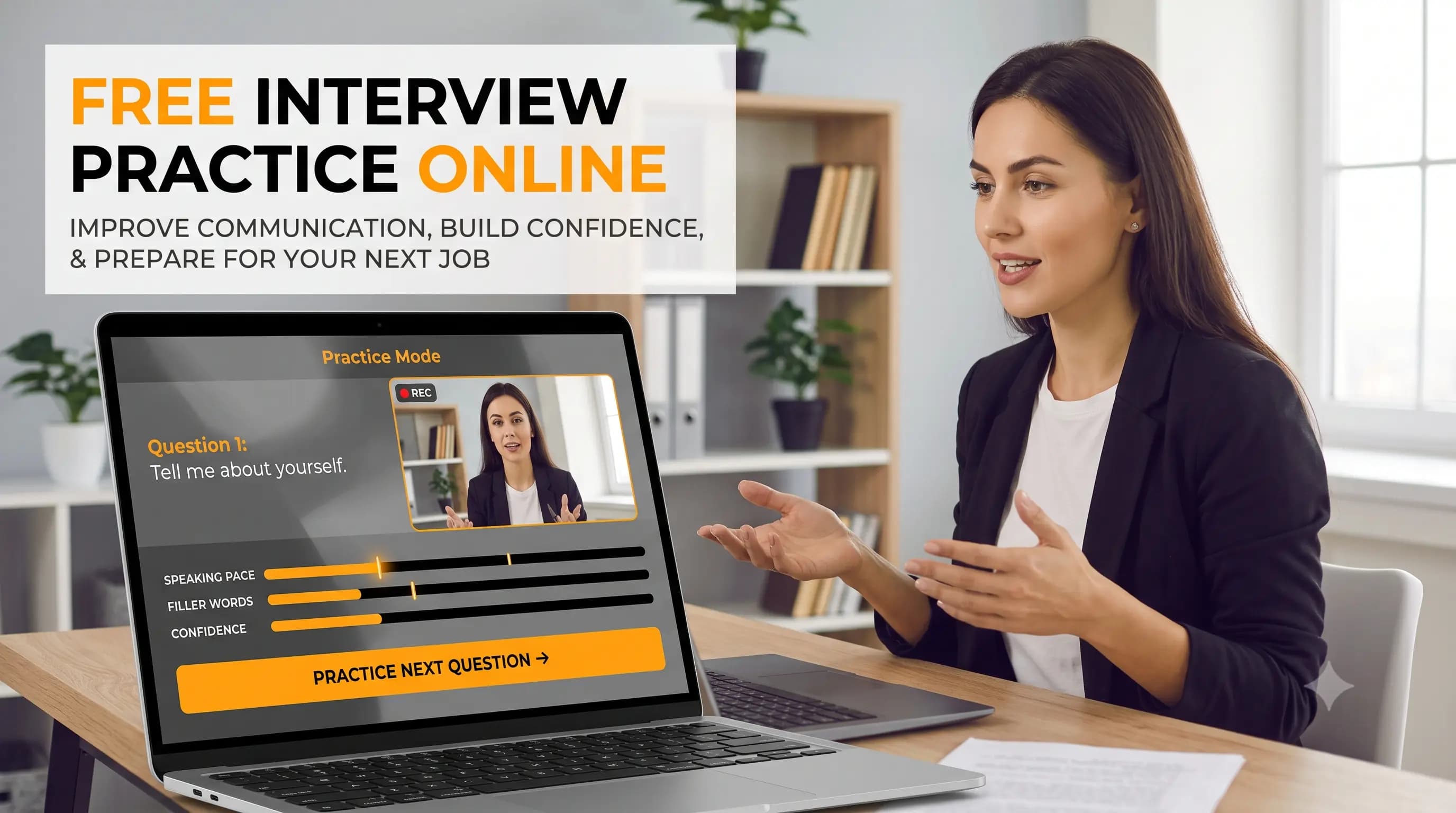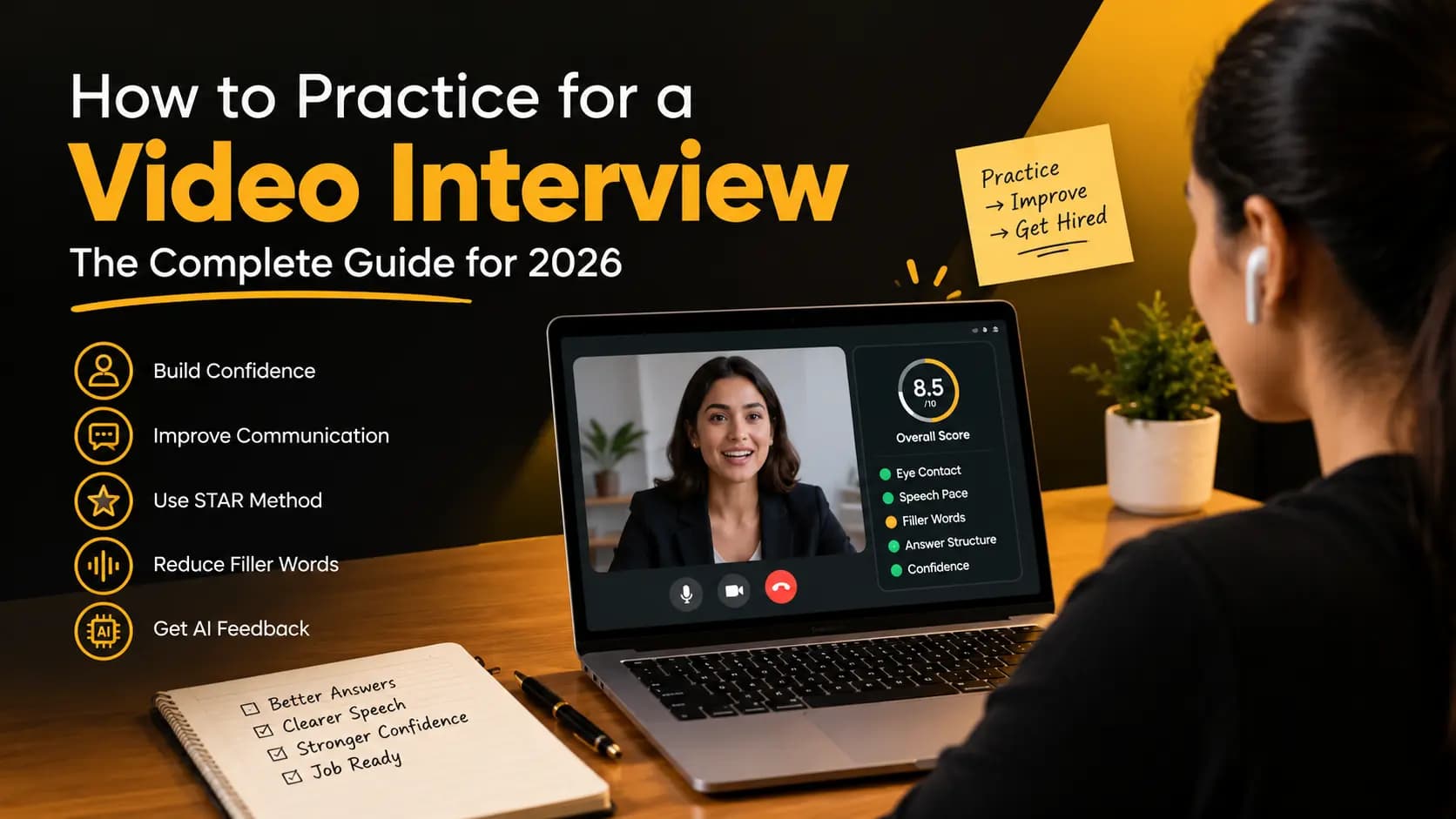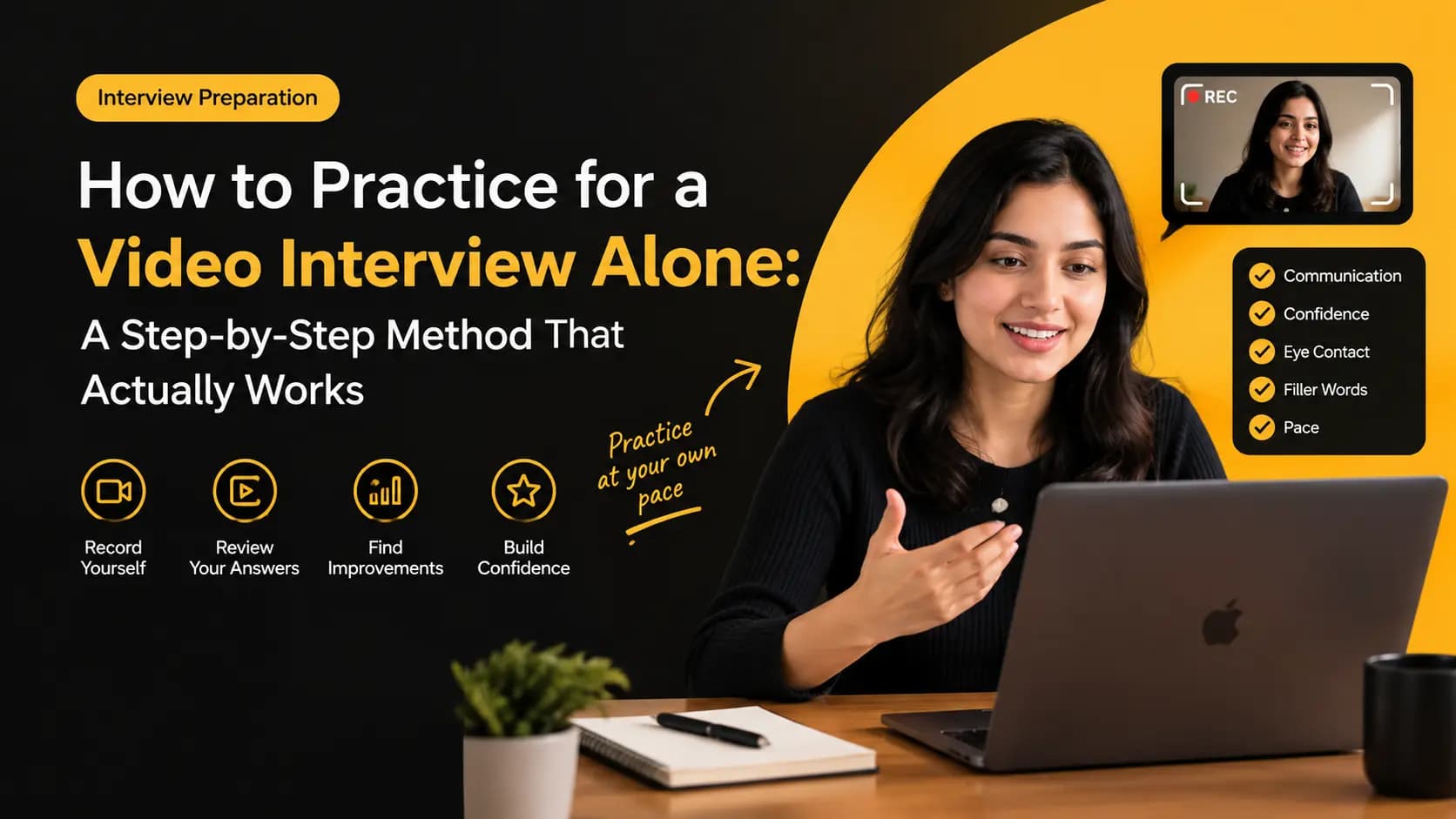
Free AI Mock Interview: How to Practice for a Job Interview Online
Practice for your next job interview with a free AI mock interview. Learn how online AI interview practice can improve your answers, confidence, communication, eye contact, speaking pace, and interview performance.
A free AI mock interview lets you practice answering job interview questions in a realistic interview environment without needing another person to act as the interviewer. The best approach is to choose common, behavioral, and role-specific questions, answer them on camera, review your responses, identify areas such as confidence, communication clarity, eye contact, speaking pace, filler words, and answer structure, and then practice again. AI interview practice can make this process more useful by providing structured feedback that helps you understand what to improve before your real interview.
Preparing for a job interview can be difficult when you do not have someone available to conduct a mock interview with you. You may read interview questions, prepare answers, watch interview videos, and research the company, but there is still one important part of preparation that is easy to miss: actually practicing your answers out loud.
A free AI mock interview can help solve this problem by giving you an opportunity to practice interview questions in an online environment. Instead of waiting for a friend, mentor, recruiter, or career coach to conduct a practice interview, you can practice on your own and receive structured feedback.
AI interview practice can be particularly useful for candidates who want to improve more than just the content of their answers. Speaking pace, communication clarity, confidence, eye contact, filler words, pauses, engagement, and answer structure can all affect how effectively you communicate during an interview.
In this guide, you will learn what an AI mock interview is, how free AI interview practice works, how to prepare for a mock interview online, which questions to practice, how to improve your answers, how to use the STAR method, what mistakes to avoid, and how VideoPitcher's free AI Interview Practice tool can help you prepare before your next job interview.
Key Takeaways
- ✓A mock interview gives you an opportunity to practice before the real interview.
- ✓AI mock interviews can let you practice without depending on another person.
- ✓Recording your answers helps you identify communication habits that may be difficult to notice in the moment.
- ✓Practice should include common, behavioral, difficult, and role-specific interview questions.
- ✓Focus on communication clarity, confidence, eye contact, speaking pace, pauses, filler words, and answer structure.
- ✓Use the STAR method when practicing behavioral interview questions.
- ✓Avoid memorizing complete answers because natural responses are usually more effective.
- ✓Repeated practice can make answering questions on camera feel more comfortable.
- ✓AI interview feedback can help you identify specific areas that need improvement.
- ✓A free AI mock interview can be used as part of a consistent interview preparation routine.
What Is a Free AI Mock Interview?
A free AI mock interview is an online interview practice experience that helps candidates simulate the process of answering job interview questions. Instead of sitting across from a recruiter or asking a friend to conduct a practice interview, you can use an AI interview practice tool to rehearse your responses.
The purpose is not to predict exactly what your interviewer will ask or guarantee a job offer. The purpose is to give you an opportunity to practice communicating your experience, skills, and ideas before the actual interview.
For candidates who are uncomfortable speaking on camera or who rarely practice interviews out loud, this can be particularly useful. You can practice repeatedly, review your responses, identify weaknesses, and make improvements without the pressure of a real hiring conversation.
Why Should You Practice With an AI Mock Interview?
Many candidates prepare for interviews by reading lists of questions and thinking about possible answers. This is useful, but mental preparation is different from actually speaking.
When you answer a question out loud, you may discover that an answer that looked excellent in your head is difficult to explain clearly. You may speak too quickly, repeat certain words, give too much background information, lose your train of thought, or struggle to organize your response.
An AI mock interview gives you a practical way to identify these issues before the real interview.
AI interview practice can help you work on:
- ✓Answer structure
- ✓Communication clarity
- ✓Confidence
- ✓Speaking pace
- ✓Eye contact
- ✓Pauses
- ✓Filler words
- ✓Engagement
- ✓Behavioral answers
- ✓On-camera communication
How Does an AI Mock Interview Work?
The exact experience can vary between AI interview platforms, but the basic process is straightforward. You select or receive interview questions, answer them as if you were speaking with an interviewer, and review your performance.
A typical AI mock interview process:
- ✓Choose the role or type of interview you want to practice.
- ✓Select common, behavioral, or role-specific questions.
- ✓Read or listen to the interview question.
- ✓Answer the question naturally.
- ✓Record your response when practicing on camera.
- ✓Review your response and feedback.
- ✓Identify one or two areas that need improvement.
- ✓Answer the question again using the feedback.
- ✓Repeat the process with additional questions.
The most important part is the final step: practice again. Feedback is valuable only when you use it to change your next response.
How to Practice for a Job Interview Online for Free
You do not need a complicated preparation routine to get value from an online mock interview. A simple process can help you gradually improve your interview performance.
Step 1: Choose the Job You Are Applying For
Start by identifying the specific role you are preparing for. Interview questions can vary significantly depending on the position, industry, seniority, and responsibilities.
Examples of roles to practice for:
- ✓Software Engineer
- ✓Frontend Developer
- ✓Backend Developer
- ✓Data Analyst
- ✓Product Manager
- ✓Project Manager
- ✓Business Analyst
- ✓Sales Representative
- ✓Marketing Manager
- ✓Customer Success Manager
- ✓HR Manager
- ✓Customer Support Representative
Once you know the role, focus your practice on the skills and responsibilities that matter for that position. A software engineer may need to explain technical decisions, while a sales candidate may need to demonstrate persuasion and communication skills.
Step 2: Practice Common Interview Questions
Begin with common interview questions because they help you build a strong foundation. These questions are often used to understand your background, motivation, strengths, experience, and interest in the role.
Common questions to practice:
- ✓Tell me about yourself.
- ✓Why do you want this job?
- ✓Why should we hire you?
- ✓What are your greatest strengths?
- ✓What is your biggest weakness?
- ✓Why do you want to work for our company?
- ✓Tell me about your previous experience.
- ✓What is your biggest professional achievement?
- ✓Tell me about a difficult problem you solved.
- ✓Where do you see yourself in five years?
Do not memorize complete responses. Instead, identify the main points you want to communicate and practice explaining them naturally.
Step 3: Practice Behavioral Interview Questions
Behavioral interview questions ask you to describe how you handled situations in the past. Employers may use these questions to understand your problem-solving, teamwork, leadership, communication, adaptability, and decision-making skills.
Examples of behavioral questions:
- ✓Tell me about a time you solved a difficult problem.
- ✓Tell me about a conflict with a colleague.
- ✓Describe a time you failed and what you learned.
- ✓Tell me about a time you worked under pressure.
- ✓Describe a time you had to meet a difficult deadline.
- ✓Tell me about a time you demonstrated leadership.
- ✓Describe a time you made a mistake at work.
- ✓Tell me about a time you had to adapt to change.
The STAR method can help you structure these answers so that you provide enough context without losing focus.
Use the STAR Method During Your AI Mock Interview
STAR stands for Situation, Task, Action, and Result. It is a useful framework for answering behavioral interview questions with specific examples.
| STAR Component | Meaning | What to Include |
|---|---|---|
| Situation | The context | Briefly explain the situation or problem. |
| Task | Your responsibility | Explain what you needed to accomplish. |
| Action | What you did | Focus on your specific actions and decisions. |
| Result | The outcome | Explain what happened and include measurable results when possible. |
For example, if an interviewer asks about a time you improved a process, do not simply say that you improved it. Explain the original situation, your responsibility, the actions you took, and the result.
Practicing STAR answers in an AI mock interview can help you become more comfortable giving structured answers without memorizing a script.
Record Yourself During an Online Mock Interview
One of the biggest advantages of video interview practice is that you can review how you actually communicate. When you are answering a question, you are focused on remembering what to say. You may not notice the habits that appear in your delivery.
Watching a recording gives you a different perspective. You can listen to your answer and observe how you communicate at the same time.
When reviewing your recording, ask:
- ✓Did I answer the question directly?
- ✓Was my answer easy to understand?
- ✓Did I speak too quickly?
- ✓Did I use too many filler words?
- ✓Did I maintain natural camera engagement?
- ✓Did I sound confident?
- ✓Did I give enough detail?
- ✓Was my answer too long?
- ✓Did I organize my ideas logically?
- ✓Did I explain the result clearly?
How AI Feedback Can Improve Your Interview Practice
Watching yourself can reveal many issues, but it is also possible to overlook habits that have become normal to you. AI interview feedback can provide another perspective by helping you identify patterns in your responses.
For example, you may believe that you communicate confidently, but discover that you frequently use phrases such as 'um,' 'actually,' 'basically,' or 'you know.' You may also notice that you speak much faster when answering difficult questions.
The goal of AI feedback should not be to chase a perfect score. The goal is to understand what you can improve and then apply that feedback to your next practice session.
Useful areas to review include:
- ✓Communication clarity
- ✓Confidence
- ✓Speaking pace
- ✓Eye contact
- ✓Filler words
- ✓Pauses
- ✓Engagement
- ✓Answer structure
- ✓Behavioral answer structure
- ✓Overall interview delivery
How to Improve Your Interview Answers
1. Start With the Main Point
Avoid spending too much time explaining background information before reaching the main point. Give the interviewer the context they need and then focus on the experience, action, or result that answers the question.
2. Use Specific Examples
Specific examples are generally more useful than vague claims. Instead of saying that you are a strong problem solver, describe a real problem you encountered, what you did, and what happened as a result.
3. Keep Your Answer Focused
Long answers can make it difficult for an interviewer to identify your main point. Practice answering questions with enough detail to demonstrate your experience while avoiding unrelated information.
4. Explain Your Contribution
When describing a team project, make your individual contribution clear. Interviewers need to understand what you personally did, what decisions you made, and how your actions affected the outcome.
5. Include Results
Whenever possible, explain the result of your actions. Numbers, percentages, time saved, revenue generated, performance improvements, or other measurable outcomes can make an example more concrete.
How to Improve Confidence With AI Interview Practice
Interview confidence usually comes from preparation and familiarity rather than trying to eliminate nervousness completely. You may still feel nervous during an interview, but repeated practice can make the process more familiar.
Start by practicing easier questions. Once you become comfortable, move to behavioral questions, difficult questions, and role-specific scenarios.
A simple confidence-building approach:
- ✓Start with familiar interview questions.
- ✓Answer them on camera.
- ✓Review your recordings.
- ✓Identify one specific weakness.
- ✓Practice the same question again.
- ✓Move to more difficult questions.
- ✓Complete a full mock interview.
- ✓Repeat the process regularly.
The objective is not to make every answer perfect. It is to become comfortable communicating your experience under interview conditions.
How to Reduce Filler Words During Interviews
Filler words such as 'um,' 'uh,' 'like,' 'basically,' 'actually,' 'you know,' and 'I mean' are common in everyday speech. Occasional filler words are normal, but frequent use can make an answer sound less polished.
The first step is awareness. Record yourself answering several questions and listen for repeated filler words. Once you know which words you use most often, practice replacing them with short pauses.
Do not try to eliminate every natural pause. A short pause can make your response sound more thoughtful and gives you time to organize your next point.
Practice Your 'Tell Me About Yourself' Answer
Tell me about yourself is one of the most common interview questions, and it is often the first opportunity you have to make a strong impression.
A simple Present → Past → Future structure can help you organize your response.
Present → Past → Future:
- ✓Present – Explain what you currently do or specialize in.
- ✓Past – Briefly describe relevant experience and achievements.
- ✓Future – Explain why the role you are applying for interests you.
Keep your answer relevant to the position. You do not need to provide your entire personal history. Focus on information that helps the interviewer understand your professional background and why you are a relevant candidate.
Practice Difficult Interview Questions
A common mistake is to practice only questions that are easy to answer. Real interviews can include unexpected or uncomfortable questions, so your practice should include situations that require you to think carefully.
Difficult questions worth practicing:
- ✓What is your biggest weakness?
- ✓Why should we hire you?
- ✓Tell me about a failure.
- ✓Tell me about a conflict at work.
- ✓Why did you leave your previous job?
- ✓Why are you changing careers?
- ✓Explain a career gap.
- ✓What salary are you expecting?
- ✓Why do you want to work here?
- ✓Tell me about a time you disagreed with your manager.
- ✓What would your previous manager say about you?
- ✓Why should we choose you over another candidate?
The objective is not to memorize a perfect response to every possible question. Instead, use difficult questions to practice staying calm, organizing your thoughts, and communicating a clear answer.
AI Mock Interview vs. Practicing With a Friend
Practicing with another person can be valuable because a friend, mentor, or career coach can ask follow-up questions and provide a human perspective. However, coordinating a practice session is not always convenient.
| Practice Method | Advantages | Limitations |
|---|---|---|
| Practicing Alone | Easy to do anytime and repeat frequently. | You may miss communication habits or weaknesses. |
| Practice With a Friend | Provides another person's perspective and follow-up questions. | Requires another person to be available. |
| AI Mock Interview | Available online, repeatable, structured, and can provide AI-based feedback. | AI feedback does not replace the judgment of a real interviewer. |
AI mock interviews and human mock interviews do not necessarily need to compete with each other. Candidates can use AI practice regularly and supplement it with human feedback when available.
10 Common AI Mock Interview Mistakes
- ✓Reading directly from a script.
- ✓Memorizing every sentence of an answer.
- ✓Practicing only easy interview questions.
- ✓Focusing only on the content of an answer and ignoring delivery.
- ✓Speaking too quickly because of nervousness.
- ✓Using excessive filler words.
- ✓Looking at your own image instead of maintaining natural camera engagement.
- ✓Giving answers that are too long.
- ✓Ignoring the result when answering behavioral questions.
- ✓Using AI feedback without actually practicing again.
How to Prepare for a Video Mock Interview
If you are practicing for a video interview, try to recreate the environment you expect during the real interview. This helps you become familiar with speaking through a camera rather than only practicing mentally.
Check your setup:
- ✓Camera – Position it approximately at eye level.
- ✓Lighting – Make sure your face is clearly visible.
- ✓Microphone – Check that your voice is clear.
- ✓Background – Keep the background clean and distraction-free.
- ✓Internet – Make sure your connection is stable.
- ✓Device – Close unnecessary applications and notifications.
- ✓Position – Sit comfortably and maintain a natural posture.
You do not need an expensive camera or studio setup. The goal is to create a clear and distraction-free environment that lets you focus on answering the interview questions.
Who Can Benefit From a Free AI Mock Interview?
AI interview practice can be useful for candidates at different stages of their careers. You do not need to be a first-time job seeker to benefit from mock interview practice.
- ✓College students preparing for their first interview.
- ✓Fresh graduates entering the job market.
- ✓Professionals applying for new positions.
- ✓Experienced candidates preparing for senior roles.
- ✓Candidates changing careers.
- ✓People applying for remote jobs.
- ✓Candidates preparing for video interviews.
- ✓People preparing for one-way video interviews.
- ✓Job seekers who feel nervous during interviews.
- ✓Professionals preparing for an important promotion or internal interview.
A Simple 15-Minute AI Interview Practice Routine
You do not need to spend hours practicing every day. A short and focused routine can help you build consistency while making it easier to identify specific weaknesses.
| Time | Activity | Goal |
|---|---|---|
| Minutes 1–2 | Choose one interview question. | Select a common, behavioral, difficult, or role-specific question. |
| Minutes 3–5 | Prepare key points. | Identify the main ideas you want to communicate. |
| Minutes 6–8 | Record your answer. | Answer naturally without reading a script. |
| Minutes 9–11 | Review feedback. | Identify one or two specific areas for improvement. |
| Minutes 12–15 | Answer again. | Apply the feedback and record an improved response. |
This routine can be repeated several times a week. As you become more comfortable, move from individual questions to complete mock interviews.
How to Get the Most From a Free AI Mock Interview
The value of an AI mock interview depends largely on how you use it. Simply completing a practice session is not enough. The goal should be to turn feedback into specific improvements.
Use this improvement cycle:
- ✓Practice one question.
- ✓Record your answer.
- ✓Review the feedback.
- ✓Choose one specific weakness.
- ✓Practice the same question again.
- ✓Compare your second response with the first.
- ✓Move to another question.
- ✓Repeat the process.
For example, if your feedback indicates that you speak too quickly, do not try to improve everything at once. Make speaking pace your focus for the next few practice questions. Once it improves, move to another area such as filler words or answer structure.
Why Video Practice Is Better Than Only Reading Interview Questions
Reading interview questions can help you understand what you might be asked. However, reading does not recreate the experience of speaking under pressure.
Think about learning to drive. Reading about driving can teach you the rules, but actual driving gives you experience. Interview preparation works in a similar way.
Reading teaches you what might be asked. Speaking teaches you how you respond. Recording lets you see how you actually communicate.
This is why an online AI mock interview can be a useful addition to traditional interview preparation.
Can AI Replace a Real Interviewer?
No. An AI mock interview is a practice tool, not a replacement for a real interviewer. A real interview can involve follow-up questions, company-specific discussions, team dynamics, technical evaluation, and other factors that cannot be completely reproduced by a practice tool.
The purpose of AI interview practice is to help you arrive at the real interview better prepared. It gives you an opportunity to rehearse your communication and identify areas that may otherwise remain unnoticed.
Think of AI mock interviews as a training environment. The real interview is still the actual test.
How VideoPitcher Helps With Free AI Interview Practice
VideoPitcher's free AI Interview Practice tool gives candidates a way to practice interview questions on camera and review different aspects of their interview performance.
Instead of only asking yourself whether an answer sounded good, you can use structured feedback to understand areas such as communication, confidence, eye contact, engagement, speaking pace, pauses, filler words, and answer structure.
The objective is not simply to receive a score. The more useful goal is to identify what you can improve before a real recruiter or hiring manager evaluates your interview performance.
Your Free AI Mock Interview Checklist
- ✓I know which role I am preparing for.
- ✓I have reviewed the job description.
- ✓I can introduce myself clearly.
- ✓I can explain why I want the position.
- ✓I can explain my relevant experience.
- ✓I can answer common interview questions.
- ✓I can answer behavioral questions using STAR.
- ✓I can provide specific examples.
- ✓I can explain measurable results.
- ✓I can maintain natural camera engagement.
- ✓I can control my speaking pace.
- ✓I can reduce unnecessary filler words.
- ✓I can answer without reading a script.
- ✓My camera and microphone work correctly.
- ✓My lighting and background are suitable.
- ✓I have completed at least one full mock interview.
- ✓I have reviewed my AI interview feedback.
- ✓I have practiced again after receiving feedback.
Ready to Practice Your Next Interview?
You can spend hours reading interview guides and preparing notes, but eventually you need to answer the questions out loud. The difference between knowing what you want to say and being able to communicate it naturally can become clear as soon as you start speaking.
A free AI mock interview gives you an opportunity to practice before the real interview. You can answer questions, record your responses, review your communication, identify weaknesses, and practice again.
VideoPitcher's free AI Interview Practice tool helps candidates practice interview questions on camera and receive structured feedback across areas that can affect interview communication and delivery.
Remember the process: Practice → Record → Review → Improve → Practice Again.
Your next interview should not be the first time you practice answering interview questions.
Frequently Asked Questions
Scorecard — implementation checklist
- Choose the job or role you are preparing for.
- Research the responsibilities and skills required for the position.
- Practice common interview questions.
- Practice role-specific interview questions.
- Practice behavioral questions using the STAR method.
- Answer questions out loud instead of only reading them.
- Record yourself answering interview questions.
- Review your communication clarity and answer structure.
- Maintain natural eye contact with the camera.
- Control your speaking pace.
- Replace unnecessary filler words with short pauses.
- Practice difficult and unexpected questions.
- Avoid memorizing complete answers.
- Test your camera, microphone, lighting, background, and internet connection.
- Complete at least one full mock interview before the real interview.
- Use AI interview feedback to identify specific areas for improvement.
Frequently asked questions
What is a free AI mock interview?+
A free AI mock interview is an online practice experience that simulates a job interview using AI. Candidates can answer interview questions, often on camera, and receive structured feedback that can help them identify areas for improvement before a real interview.
Is there a free AI tool for mock interviews?+
Yes. VideoPitcher provides a free AI Interview Practice tool that allows candidates to practice interview questions online and review areas such as communication, confidence, eye contact, speaking pace, pauses, filler words, and answer structure.
How can I practice for a job interview online for free?+
You can practice for a job interview online by selecting common, behavioral, and role-specific questions, answering them on camera, reviewing your responses, identifying weaknesses, and practicing again. A free AI mock interview tool can make this process more structured by providing feedback on your interview performance.
Can AI conduct a mock interview?+
Yes. AI interview practice tools can simulate interview questions and provide a structured practice experience. Candidates can use AI mock interviews to rehearse answers and identify communication habits before a real interview.
Are AI mock interviews useful?+
AI mock interviews can be useful because they allow candidates to practice repeatedly without depending on another person. They can also provide structured feedback that helps candidates identify issues such as excessive filler words, fast speaking pace, unclear answers, weak structure, or limited camera engagement.
What questions should I practice in an AI mock interview?+
Practice common questions such as 'Tell me about yourself,' 'Why should we hire you?' and 'Why do you want this job?' You should also practice behavioral, role-specific, technical, situational, and difficult interview questions relevant to the position.
Can AI help improve interview confidence?+
Repeated AI interview practice can help candidates become more comfortable answering questions on camera. Recording responses and reviewing feedback can also help identify specific communication habits that may affect confidence and delivery.
Should I memorize my answers before a mock interview?+
It is generally better to prepare key points instead of memorizing complete answers. Understanding the main ideas allows you to respond naturally while still keeping your answers focused and structured.
How many times should I practice a mock interview?+
There is no fixed number of practice sessions that works for everyone. A useful approach is to practice several questions, review your performance, improve one or two specific weaknesses, and repeat the questions until your delivery becomes more natural and confident.
How does VideoPitcher help with AI mock interviews?+
VideoPitcher's free AI Interview Practice tool lets candidates practice interview questions on camera and receive structured feedback across areas such as communication, confidence, eye contact, engagement, speaking pace, pauses, filler words, and answer structure.
Written by VideoPitcher Editorial Team
Interview & Talent Technology Desk
Published September 11, 2026
Keywords covered
Related resources
Ready to transform your hiring process?
Start using VideoPitcher today with 20 FREE AI Video Screening Credits, plus Unlimited AI Resume Analysis and Unlimited Text Screening Assessments. No credit card is required—just start screening smarter and find the right candidates faster.