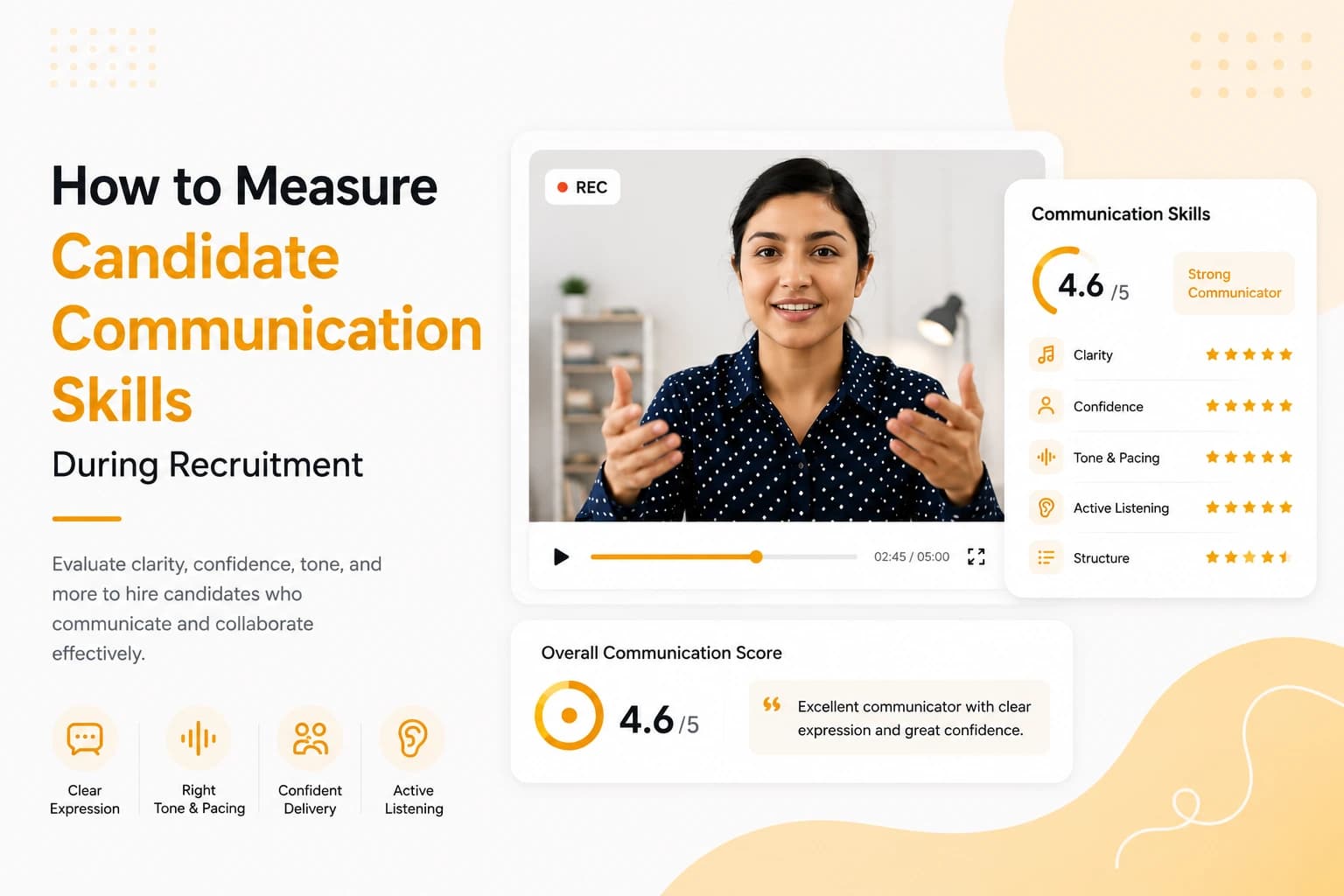
How to Assess Customer Service Skills in Candidates: 20 Interview Questions, Scoring Rubric & Video Assessment Guide
Discover 20 customer service interview questions, what to look for in candidate answers, and how to build a structured assessment with a practical scoring rubric.
To assess customer service skills effectively, evaluate communication, active listening, empathy, problem-solving, patience, conflict resolution, and product knowledge. Ask candidates practical, scenario-based questions, use consistent scoring criteria, and combine written and video responses to understand how they approach real customer situations. A structured assessment helps hiring teams compare candidates using relevant evidence rather than relying only on resumes or unstructured interviews.
Hiring the right customer service representative is about much more than finding someone who can speak confidently or has previous experience handling customers. The person you hire needs to listen carefully, understand customer problems, remain patient in difficult situations, and find practical solutions while maintaining a professional attitude.
A candidate may have an impressive resume and perform well during a traditional interview, but that does not automatically mean they can handle an angry customer, explain a complicated issue, or manage several requests at the same time.
This is why customer service interview questions should go beyond general questions about strengths and weaknesses. Hiring teams need practical scenarios that reveal how candidates think, communicate, respond to pressure, and approach real customer interactions.
In this guide, you will find 20 customer service interview questions, the skills each question evaluates, examples of strong answer signals, a practical scoring rubric, and a step-by-step approach to building a structured customer service assessment using video and text responses.
Key Takeaways
- ✓A strong customer service candidate needs more than good communication skills.
- ✓Scenario-based questions reveal how candidates approach real customer problems.
- ✓Evaluate empathy, active listening, patience, and problem-solving.
- ✓Use a consistent scoring rubric to compare candidates fairly.
- ✓Written assessments help evaluate email and chat communication.
- ✓Video assessments provide additional insight into spoken communication.
- ✓Structured assessments make early-stage recruitment more organized.
- ✓VideoPitcher helps teams collect video and text responses and review candidate insights.
Why Is Assessing Customer Service Skills Important?
Customer service representatives directly influence how customers experience a business. They handle questions, resolve complaints, explain products, manage expectations, and sometimes deal with people who are already frustrated.
A candidate might have previous experience in customer support, but experience alone does not guarantee that they can communicate clearly or solve problems effectively. Similarly, someone with limited experience might demonstrate excellent listening skills, patience, and the ability to understand customer needs.
This is why recruiters should evaluate candidates using practical questions and job-related scenarios instead of relying entirely on resumes or general conversations.
What Can Go Wrong When Customer Service Skills Are Not Evaluated?
- ✓Employees may struggle to handle difficult customer conversations.
- ✓Customer complaints may take longer to resolve.
- ✓Poor communication can create misunderstandings.
- ✓Customers may receive inconsistent information.
- ✓Support teams may spend additional time correcting avoidable mistakes.
- ✓Managers may need to invest more time in training and supervision.
A structured assessment helps hiring teams identify these potential gaps before making a hiring decision. It also creates a more consistent way to evaluate applicants applying for the same position.
8 Essential Customer Service Skills to Evaluate
Before preparing interview questions, identify the competencies that matter most for the position. A customer service representative working in a call center may require different skills from someone handling email support or technical customer queries.
1. Communication Skills
Candidates should be able to explain information clearly, organize their thoughts, and communicate professionally. They should avoid unnecessarily complicated explanations and adapt their language to the customer's level of understanding.
2. Active Listening
Good customer service starts with understanding the actual problem. Candidates should demonstrate that they can listen carefully, identify important details, and ask relevant questions before suggesting a solution.
3. Empathy
Empathy helps representatives understand a customer's frustration or concern. Look for candidates who acknowledge customer feelings without making unrealistic promises.
4. Problem-Solving
Customer support representatives regularly encounter unfamiliar problems. They should be able to understand a situation, consider available options, and identify a practical next step.
5. Patience and Emotional Control
Some customers may be upset, impatient, or difficult to communicate with. Candidates should remain professional instead of reacting emotionally.
6. Conflict Resolution
Representatives need to handle disagreements, complaints, and misunderstandings. Look for candidates who focus on resolving the issue rather than blaming the customer or another department.
7. Adaptability
Customer situations can change quickly. Candidates should be comfortable adjusting their approach when a customer needs additional explanation or when the original solution does not work.
8. Time Management and Prioritization
Customer service employees often handle multiple requests. They should understand how to prioritize urgent issues without ignoring other customers.
20 Customer Service Interview Questions to Ask Candidates
The following questions cover common customer service situations, behavioral competencies, and practical problem-solving. Recruiters can select the questions that best match their job requirements instead of asking every candidate all 20 questions.
Section 1: Communication and Active Listening
1. How would you explain a complicated product or service to a customer who has no technical knowledge?
What to evaluate: Communication clarity, patience, and the ability to simplify complex information.
Strong answer signals: The candidate explains that they would avoid technical terminology, break the information into smaller steps, use examples, and confirm whether the customer understands.
2. What would you do if a customer did not understand your explanation?
What to evaluate: Active listening, adaptability, and communication.
Strong answer signals: The candidate would ask which part is unclear, rephrase the explanation, use a different example, and avoid making the customer feel uncomfortable.
3. How do you make sure you have understood a customer's problem correctly?
What to evaluate: Listening, clarification, and attention to detail.
Strong answer signals: The candidate describes listening without interrupting, asking relevant follow-up questions, and summarizing the customer's concern before recommending a solution.
4. How would you handle a customer who is confused about a company's policy?
What to evaluate: Explanation skills, patience, and policy awareness.
Strong answer signals: The candidate would explain the policy in simple language, clarify relevant conditions, and provide available alternatives without making unauthorized promises.
Section 2: Handling Difficult Customers and Complaints
5. How would you handle an angry customer who is shouting at you?
What to evaluate: Patience, emotional control, empathy, and conflict resolution.
Strong answer signals: The candidate would remain calm, listen to the complaint, acknowledge the customer's frustration, and focus on understanding and resolving the issue.
6. Tell me about a time you handled a difficult customer.
What to evaluate: Previous experience, ownership, communication, and practical problem-solving.
Strong answer signals: The candidate provides a specific example, explains the situation, describes their actions, and communicates the outcome. Use follow-up questions to understand their personal contribution.
7. What would you do if a customer blamed you for a problem you did not cause?
What to evaluate: Professionalism, emotional maturity, and ownership.
Strong answer signals: The candidate avoids arguing, acknowledges the inconvenience, investigates the problem, and takes responsibility for helping the customer reach the appropriate team or solution.
8. How would you respond if a customer demanded a refund that violated company policy?
What to evaluate: Decision-making, communication, and policy compliance.
Strong answer signals: The candidate explains the policy respectfully, avoids false promises, and explores legitimate alternatives or escalation options.
Section 3: Problem-Solving and Decision-Making
9. A customer reports that a product is not working. How would you troubleshoot the issue?
What to evaluate: Logical thinking, troubleshooting, and communication.
Strong answer signals: The candidate gathers relevant information, identifies possible causes, follows troubleshooting steps, and explains the next action clearly.
10. What would you do if you could not immediately find a solution to a customer's problem?
What to evaluate: Resourcefulness, honesty, and ownership.
Strong answer signals: The candidate would acknowledge the issue, consult relevant documentation or colleagues, escalate when appropriate, and communicate realistic expectations.
11. How would you prioritize multiple customer requests arriving at the same time?
What to evaluate: Time management, prioritization, and decision-making.
Strong answer signals: The candidate considers urgency, business impact, response commitments, and customer needs while keeping other customers informed.
12. What would you do if you gave a customer incorrect information?
What to evaluate: Accountability, honesty, and corrective action.
Strong answer signals: The candidate accepts responsibility, corrects the information promptly, explains the accurate details, and takes steps to avoid repeating the mistake.
Section 4: Behavioral and Situational Questions
13. Describe a situation where you went beyond your regular responsibilities to help a customer.
What to evaluate: Initiative, customer focus, and ownership.
Strong answer signals: The candidate explains a real situation, identifies the additional steps they took, and describes the outcome without exaggerating their contribution.
14. How would you handle a customer who repeatedly contacts support about the same problem?
What to evaluate: Patience, investigation, and follow-through.
Strong answer signals: The candidate reviews previous interactions, identifies why earlier solutions did not work, and develops a more complete resolution plan.
15. Tell me about a time you received negative feedback. How did you respond?
What to evaluate: Coachability, self-awareness, and willingness to improve.
Strong answer signals: The candidate describes the feedback objectively, explains what they learned, and provides an example of how they changed their approach.
16. How would you manage a conversation with a customer who refuses to follow the troubleshooting instructions?
What to evaluate: Patience, adaptability, and persuasion.
Strong answer signals: The candidate explores why the customer is reluctant, explains the purpose of the steps, offers alternative approaches when possible, and remains respectful.
Section 5: Teamwork, Adaptability and Professionalism
17. How would you handle a situation where you disagree with a colleague about how to resolve a customer issue?
What to evaluate: Teamwork, communication, and professional judgment.
Strong answer signals: The candidate focuses on available evidence, discusses the issue respectfully, and prioritizes the customer's needs and company procedures.
18. How do you stay organized when handling several customer conversations?
What to evaluate: Organization, time management, and attention to detail.
Strong answer signals: The candidate describes using approved tools, maintaining accurate notes, tracking follow-ups, and prioritizing requests.
19. What would you do if company procedures changed and customers were unfamiliar with the new process?
What to evaluate: Adaptability, learning ability, and communication.
Strong answer signals: The candidate learns the updated process, communicates changes clearly, and helps customers understand what they need to do.
20. What does excellent customer service mean to you?
What to evaluate: Customer orientation, professional values, and understanding of service quality.
Strong answer signals: The candidate discusses understanding customer needs, communicating honestly, resolving issues effectively, and creating a positive and reliable experience.
Customer Service Interview Scoring Rubric
Asking the right questions is only one part of candidate evaluation. Recruiters also need a consistent method for understanding and comparing responses. Without a defined scoring system, different interviewers may judge the same answer differently.
A five-point scoring rubric provides a simple starting point. Define the meaning of each score before reviewing candidate submissions so that evaluations are based on consistent expectations.
| Score | Evaluation Level | What It Indicates |
|---|---|---|
| 1 | Poor | Does not address the question, provides unclear reasoning, or demonstrates significant competency gaps. |
| 2 | Below Expectations | Shows limited understanding and provides incomplete or weak examples. |
| 3 | Meets Expectations | Provides a reasonable response and demonstrates the required basic competency. |
| 4 | Strong | Provides a clear, relevant response with good reasoning and practical examples. |
| 5 | Excellent | Demonstrates strong judgment, clear communication, empathy, and a practical approach. |
Recommended Customer Service Evaluation Criteria
| Competency | Suggested Weight | What to Evaluate |
|---|---|---|
| Communication | 20% | Clarity, explanation, and professional language. |
| Active Listening | 15% | Understanding questions and identifying customer needs. |
| Empathy | 15% | Acknowledging concerns and responding appropriately. |
| Problem-Solving | 20% | Reasoning, troubleshooting, and finding solutions. |
| Conflict Resolution | 15% | Handling complaints and difficult situations. |
| Professionalism | 10% | Patience, accountability, and appropriate conduct. |
| Adaptability | 5% | Adjusting to changing customer requirements. |
These percentages are an illustrative starting point, not a universal standard. Adjust the weight of each competency based on the actual responsibilities of the position. For example, technical support roles may require a higher problem-solving weight, while chat support roles may place greater emphasis on written communication.
Example of Calculating a Candidate's Weighted Score
Suppose a candidate receives a score of 4 out of 5 for communication. With a competency weight of 20%, the weighted contribution is 16 percentage points.
Calculate each competency using the following formula: (Candidate Score / 5) × Competency Weight. Add all weighted contributions to obtain the overall assessment score.
For example, a candidate scoring 4 in communication, 3 in listening, 5 in empathy, 4 in problem-solving, 4 in conflict resolution, 4 in professionalism, and 3 in adaptability would receive an illustrative weighted score of 79%.
Use the overall score as one input into the hiring decision, not as an automatic selection rule. Review the individual competency scores and supporting evidence before deciding which candidates should move forward.
How to Build a Customer Service Candidate Assessment
A structured customer service assessment should test the competencies that matter for the actual position. Instead of creating a long questionnaire with unrelated questions, focus on a small number of high-value tasks.
Step 1: Identify the Role Requirements
Start by understanding what the employee will actually do. Will they handle inbound calls, email requests, live chat, technical complaints, order issues, or a combination of different channels?
Identify the essential competencies and separate must-have requirements from skills that can be developed through training.
Step 2: Select Relevant Questions
Choose approximately 5-10 questions that cover the most important competencies. Include a combination of behavioral and situational questions.
Avoid asking several questions that test exactly the same skill. Each question should provide useful information for the hiring decision.
Step 3: Choose Between Video and Text Responses
Different assessment formats help evaluate different abilities. Video responses allow candidates to explain their thinking verbally, while written responses help recruiters evaluate written communication and professional language.
| Assessment Format | Best Used For |
|---|---|
| Video Response | Spoken communication, explanation, customer interaction scenarios, and verbal reasoning. |
| Text Response | Email writing, live-chat responses, written clarity, grammar, and customer messaging. |
Step 4: Define the Scoring Rubric
Create clear evaluation criteria before candidates begin the assessment. Define what a weak, acceptable, and strong response looks like for each competency.
This gives hiring managers a common evaluation framework and makes it easier to discuss candidate strengths and development areas.
Step 5: Review Candidate Responses and Collaborate
Once candidates complete their assessments, review their answers against the predefined criteria. Recruiters can focus on communication and customer handling, while support managers evaluate technical reasoning and operational knowledge.
Combining different perspectives helps create a more complete picture of each candidate. Record the evidence behind important ratings instead of relying only on general impressions.
Video Assessment vs Traditional Phone Screening
Traditional phone screening is a common first step in recruitment. However, coordinating calls with every applicant can become difficult when a role attracts a large number of applications.
Asynchronous video assessments provide another way to collect candidate responses. Candidates receive an assessment and complete their responses at a convenient time within the configured requirements. Recruiters can review submissions later without scheduling a separate first-round call for every applicant.
| Area | Traditional Phone Screening | Asynchronous Assessment |
|---|---|---|
| Scheduling | Requires coordination between candidates and recruiters. | Candidates complete responses independently. |
| Availability | Limited by interviewer schedules. | Responses can be reviewed when convenient. |
| Consistency | Questions may vary between conversations. | The same predefined questions can be used. |
| Review | Often depends on notes taken during calls. | Submitted responses can be revisited. |
| Team Collaboration | Often requires sharing call notes or arranging additional discussions. | Team members can review candidate submissions and evaluation notes. |
| Written Skills | Usually require an additional exercise. | Can be evaluated through integrated text questions. |
These approaches serve different purposes. An asynchronous assessment can make initial screening more flexible, while live interviews remain valuable for follow-up discussions, deeper conversations, and final hiring decisions.
Common Mistakes to Avoid When Assessing Customer Service Candidates
Avoid these common recruitment mistakes:
- ✓Hiring based only on previous customer service experience.
- ✓Asking generic questions that do not reveal practical abilities.
- ✓Evaluating communication without assessing listening and problem-solving.
- ✓Using different evaluation criteria for different candidates.
- ✓Focusing too much on confidence instead of the quality of the response.
- ✓Ignoring written communication skills for chat and email support roles.
- ✓Using unrealistic customer scenarios.
- ✓Making decisions based entirely on one interviewer's opinion.
- ✓Treating an AI-generated score as the only basis for hiring.
- ✓Failing to explain the assessment process to candidates.
A good assessment should be relevant to the actual job, consistent across candidates, accessible, and supported by clear evaluation criteria. Recruiters should also review individual responses and use human judgment when making final hiring decisions.
How VideoPitcher Helps Recruiters Assess Customer Service Candidates
Creating a structured assessment is useful, but managing candidate responses, organizing evaluations, and reviewing applicants can become challenging when several people are involved in recruitment.
VideoPitcher brings video and text-based candidate assessments together in a single hiring workflow. Hiring teams can create assessments for specific positions, attach them to job listings, and allow candidates to submit their resumes and responses.
Candidates can complete their assigned video and text responses at their own pace, while recruiters review submissions and use AI-assisted insights to support their evaluation.
1. Create Role-Specific Assessments
Prepare questions that reflect the responsibilities of your customer service position. For example, you can create video questions about handling angry customers and text exercises that ask candidates to write a professional email response.
2. Collect Video and Text Responses
Use video responses to understand how candidates explain situations verbally and written questions to evaluate their ability to communicate through email or chat.
3. Review AI-Assisted Candidate Insights
VideoPitcher analyzes submitted resumes and assessment responses to provide hiring teams with additional candidate insights. These insights can support the review process alongside the actual responses and job-related evaluation criteria.
4. Collaborate With Your Hiring Team
Recruiters and hiring managers can review candidate submissions, evaluate relevant skills, and discuss their findings. This creates a more organized approach to candidate shortlisting.
5. Move Qualified Candidates to the Next Stage
Once the initial assessment is complete, your team can identify candidates who meet the defined requirements and invite them for further interviews.
VideoPitcher is designed to support early-stage candidate screening, not replace the judgment and conversations needed to make a final hiring decision.
A Practical Customer Service Assessment Template
Here is an example of how a recruiter can organize a short assessment for a customer service representative position. Adjust the questions and evaluation criteria according to the responsibilities of your role.
| Question | Response Type | Competency |
|---|---|---|
| How would you handle an angry customer? | Video | Empathy and conflict resolution |
| Explain a complicated service to a non-technical customer. | Video | Communication |
| Write an email responding to a delayed order complaint. | Text | Written communication |
| How would you prioritize three customer requests? | Video | Decision-making |
| Describe a difficult customer problem you resolved. | Video | Problem-solving |
| Write a professional response to a refund request. | Text | Policy understanding and professionalism |
| How do you make sure you understand a customer's issue? | Video | Active listening |
This template provides a balanced starting point by combining spoken communication with practical written tasks. You can add role-specific questions for technical support, inbound sales support, BPO operations, or customer success positions.
Frequently Asked Questions
Final Customer Service Candidate Evaluation Checklist
- ✓The candidate communicates clearly and professionally.
- ✓They demonstrate active listening.
- ✓They show empathy toward customer concerns.
- ✓They can explain complicated information simply.
- ✓They approach problems logically.
- ✓They remain professional in difficult situations.
- ✓They understand the importance of company policies.
- ✓They demonstrate appropriate conflict-resolution skills.
- ✓They can manage multiple customer requests.
- ✓Their responses meet the role's predefined evaluation criteria.
- ✓Their assessment results have been reviewed by the hiring team.
Conclusion: Build a Better Customer Service Hiring Process
Hiring effective customer service representatives requires more than reviewing resumes and asking a few general interview questions. Recruiters need to understand how candidates communicate, listen, solve problems, handle complaints, and respond to real customer situations.
Using structured interview questions, realistic scenarios, and consistent scoring criteria makes it easier to evaluate candidates against the actual requirements of a position. Combining video and written assessments can provide additional evidence of how candidates communicate across different customer support channels.
With VideoPitcher, hiring teams can create role-specific assessments, collect candidate video and text responses, review AI-assisted insights, and collaborate on candidate evaluations in a structured workflow.
Whether you are hiring for a customer support team, a BPO operation, or a growing business, a more structured screening process can help you spend less time on repetitive initial screening and more time evaluating candidates who meet your requirements.
Ready to improve the way you screen customer service candidates? Explore VideoPitcher and create your first structured candidate assessment.
Scorecard — implementation checklist
- Identify the most important customer service competencies for the position.
- Prepare realistic scenario-based interview questions.
- Evaluate communication and active listening.
- Assess empathy and conflict resolution.
- Test practical problem-solving abilities.
- Use consistent scoring criteria.
- Include written and video response exercises where appropriate.
- Compare candidates using job-related evidence.
- Involve relevant team members in candidate reviews.
- Use structured assessments before moving candidates to live interviews.
Frequently asked questions
What are the most important customer service interview questions?+
Important customer service interview questions cover handling angry customers, resolving complaints, active listening, communication, problem-solving, prioritization, teamwork, and working under pressure. Scenario-based questions are particularly useful because they reveal how candidates approach realistic customer situations.
How do you assess customer service skills during recruitment?+
Assess customer service skills using structured behavioral questions, realistic customer scenarios, written communication exercises, and video responses. Evaluate candidates against consistent criteria such as communication, empathy, problem-solving, patience, and professionalism.
What skills should a customer service representative have?+
A customer service representative should demonstrate clear communication, active listening, empathy, patience, problem-solving, conflict resolution, adaptability, teamwork, and the ability to manage customer expectations.
How many questions should a customer service assessment include?+
A practical starting point is 5-10 carefully selected questions covering the most important job-related competencies. The exact number depends on the role, assessment duration, and depth of evaluation required.
Are video assessments useful for customer service hiring?+
Video assessments allow candidates to explain how they would handle customer situations in their own words. Recruiters can review communication, clarity, and the reasoning behind responses asynchronously and compare submissions using consistent evaluation criteria.
How do you score customer service interview answers?+
Use a consistent scoring rubric, such as a five-point scale, to evaluate communication, empathy, problem-solving, professionalism, and role-specific knowledge. Define what each score represents before evaluating candidates.
Can written assessments be used for customer service recruitment?+
Yes. Written assessments are useful for evaluating email responses, chat communication, written clarity, grammar, and the ability to explain solutions professionally. They can be combined with video responses for a broader evaluation.
How can VideoPitcher help with customer service hiring?+
VideoPitcher enables hiring teams to create structured video and text assessments, collect candidate responses asynchronously, review AI-assisted resume and assessment insights, and collaborate on candidate evaluations. This helps teams organize their initial screening process before scheduling live interviews.
Written by VideoPitcher Editorial Team
Talent Acquisition & HR Technology Desk
Published November 23, 2026
Keywords covered
Related resources
Ready to transform your hiring process?
Start using VideoPitcher to collect and review candidate assessments with your team.