The Complete Guide to Pre-Hire Assessments in 2026
Everything hiring teams need to know about pre-hire assessments in 2026: what they are, how to design them, which tools to use, and how to build a screening funnel that shortlists the right candidates fast.
The definitive guide to pre-hire assessments. Learn how to design video and text screening sessions, build scoring rubrics, and shortlist top candidates before the first live interview. Start with 20 free credits.
A pre-hire assessment is any structured evaluation you run on candidates before the first live interview. The goal is simple: surface the people worth your time, and filter out the ones who aren't — before a single calendar invite goes out. Done well, a pre-hire assessment compresses a 30-day hiring cycle into 10 days, reduces the cost of screening by 60–80%, and delivers more predictive signal about a candidate's actual job performance than a resume or unstructured phone call ever could.
In 2026, pre-hire assessments have become the standard first gate for high-performing hiring teams across industries. This guide covers everything you need to know: what pre-hire assessments are, the different types available, how to design one that candidates actually complete, how to score and review submissions fairly, and which video and text assessment tools are best suited for different hiring contexts. Whether you're building your first screening process or optimizing an existing funnel, this is the complete reference.
What Is a Pre-Hire Assessment?
A pre-hire assessment is a structured evaluation completed by a candidate before they meet anyone on your team. Unlike a live phone screen or video interview, a pre-hire assessment is asynchronous — candidates complete it on their own schedule, and your team reviews submissions on their own schedule. There is no coordination, no calendar back-and-forth, and no limit on how many candidates you can assess simultaneously.
Pre-hire assessments come in two broad categories. The first is skills-based: coding challenges, aptitude tests, writing samples, or task-specific assignments that test whether a candidate can actually do the job's technical requirements. The second is communication and behavioral: structured video and text responses to open-ended questions that reveal how a candidate thinks, communicates, and approaches problems — dimensions that no automated test can measure.
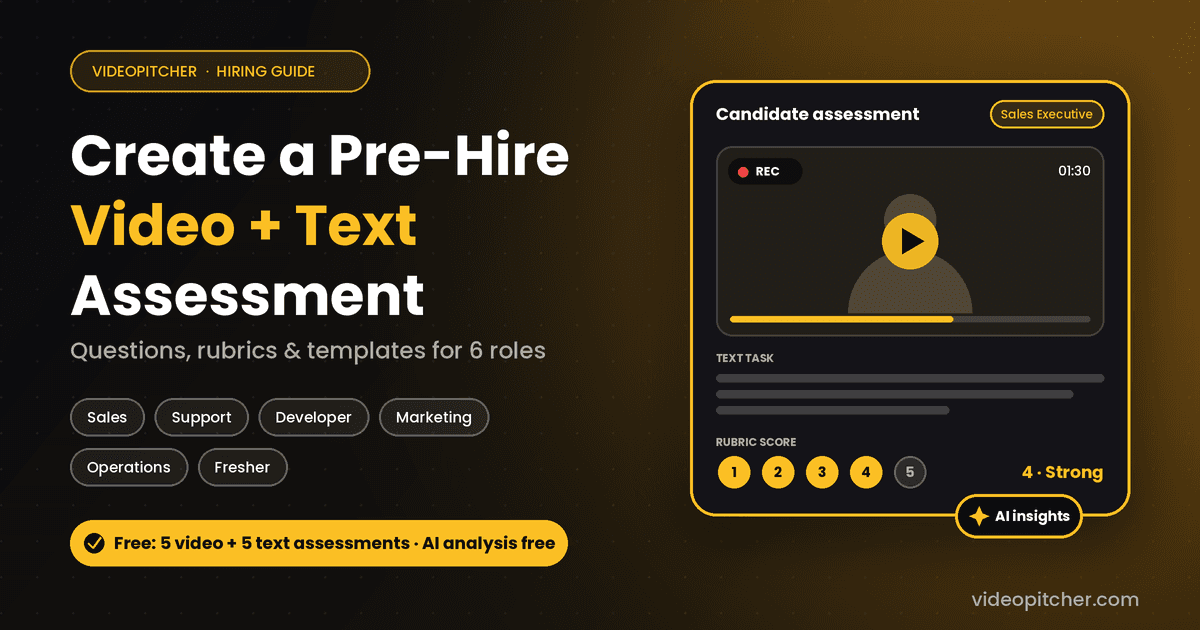
The most effective pre-hire assessment combines both. A first-round screen with 1–2 knockout text questions (minimum qualifications) plus 2–3 video questions (communication, reasoning, role fit) gives you a complete first-pass evaluation that a recruiter can review in under 5 minutes per candidate. This combination — not one or the other — is what high-volume, high-quality hiring teams are running in 2026.
Why Pre-Hire Assessments Work: The Evidence
Structured assessments are consistently more predictive of job performance than unstructured interviews. Research across hiring psychology shows that unstructured conversations suffer from halo effects, primacy bias, and interviewer-specific inconsistency — the same candidate evaluated by two different interviewers can receive dramatically different scores. Pre-hire assessments impose structure that forces consistent evaluation across your entire candidate pool.
Asynchronous video specifically reduces the 'warm-up' effect of live interviews, where candidates often perform better in later rounds simply because they've practiced. In an async assessment, every candidate encounters the questions fresh and responds without the benefit of having heard the questions from a previous interviewer. This makes early-funnel evaluation more reliable as a true first-impression signal.
Speed is the other evidence-based advantage. The average time-to-hire for roles that use async screening drops by 40–60% compared to those relying on phone screens. When candidates can complete an assessment at 9pm after work and a recruiter can review 15 submissions between meetings the next morning, the 3–4-day scheduling delay of a single phone screen round disappears entirely.
Types of Pre-Hire Assessments: Choosing the Right One
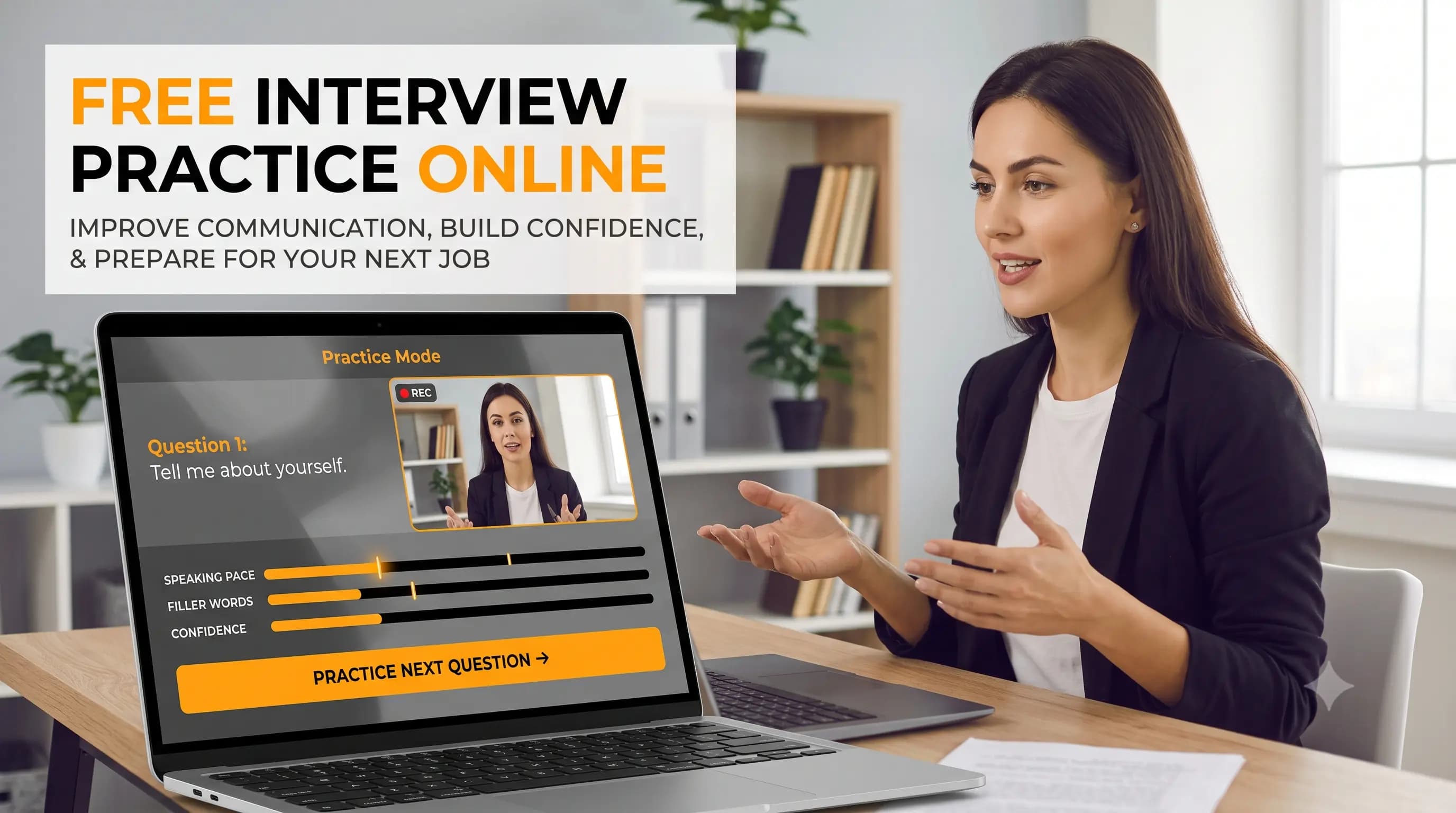
Video response assessments are the most versatile type. A candidate records answers to structured questions — explaining their past experience, walking through a problem-solving approach, or describing how they'd handle a role-specific scenario. Video assessments reveal communication clarity, structured thinking, and professional presence in a way that text alone cannot. They work for virtually any role category.
Text response assessments are ideal for knockout questions and written skill evaluation. Ask candidates to describe their experience with a specific tool, explain a decision they made, or write a brief analysis of a scenario. Text responses are faster for both candidates to complete and reviewers to evaluate — a strong complement to video questions in the same session.
Skills and task-based assessments are best reserved for the second round, after video screening has filtered out unqualified candidates. Using an expensive, time-consuming coding test or case study as a first-round filter wastes the test on candidates who would have been filtered by a simple communication screen. Sequencing matters: use video in round 1, skills tests in round 2.
Written work samples — a writing test, a strategic memo, a project plan — work well for content, operations, and leadership roles. These are best delivered as private assessment links to pre-qualified candidates who've passed a first-round video screen, ensuring you're only asking your strongest candidates to invest significant time in the evaluation.
How to Design a High-Completion Pre-Hire Assessment
The biggest design mistake is making the assessment too long. Every minute you add to a first-round assessment reduces your completion rate. For a public link shared on a job board, aim for 10–15 minutes total. For a private link sent to sourced candidates, 15–20 minutes is acceptable. Anything beyond 20 minutes for an unpaid first-round assessment will result in significant drop-off, especially from top candidates who have multiple opportunities.
Start with 1–2 knockout questions in text format. These should filter unqualified candidates immediately: minimum years of experience, required certifications, availability date, geographic requirements, or compensation expectations. Candidates who don't meet basic minimums should be obvious from these responses, and they take 30 seconds to evaluate — freeing reviewers to spend their time only on viable candidates.
Follow with 2–3 video questions targeting the competencies that actually predict success in the role. For sales: persuasion and energy. For engineering: structured thinking and communication clarity. For customer success: empathy and problem-solving. Keep time limits at 60–90 seconds per video response — long enough for depth, short enough to force conciseness. Conciseness itself is a skill worth evaluating. See the question design guide for specific question frameworks by role.
End with a clear expectation-setting note: what happens next, when candidates can expect to hear back, and what the rest of the process looks like. Candidates who invest time in an assessment deserve transparency about the timeline. This small gesture significantly improves your employer brand perception — even for candidates who don't advance.
Distributing Your Assessment: Public vs Private Links
How you distribute your assessment is as important as how you design it. Public links are shareable URLs that any candidate can access — post them in job descriptions, careers pages, LinkedIn posts, or job boards. Public links maximize top-of-funnel volume and enable self-service screening, where interested candidates opt in by completing the assessment rather than submitting a passive application.
Private links are sent directly to specific candidates — ideal for referrals, sourced talent, or second-round assessments where you're following up with candidates who passed round 1. Private links feel more personal ('we'd like to learn more about you specifically') and generate higher completion rates than public links because recipients perceive them as active invitations rather than automated filters.
The most effective funnels use a tiered approach: public link with 3–4 questions for broad first-round screening, followed by a private link with more detailed or role-specific questions for candidates who advance. This keeps your first-round assessment short enough to maintain completion rates while reserving deeper evaluation for the candidates who've already demonstrated baseline viability.
Scoring and Reviewing Submissions: Building a Fair Process
Consistency in evaluation starts before the first submission arrives. Define your scoring rubric before you share the assessment link — not after you've watched the first video. For each question, write down what a 5-star answer looks like, what a 3-star answer looks like, and what a 1-star answer looks like. Share this rubric with every reviewer who will evaluate submissions. This alignment prevents the drift that occurs when different reviewers are applying different standards to the same question.
Use a 1–5 scale per question rather than a binary yes/no rating. Nuance in scoring allows you to distinguish between 'clearly not qualified' (1–2), 'uncertain' (3), and 'shortlist candidate' (4–5). When multiple reviewers score independently and their averages are aggregated, the resulting shortlist reflects team consensus rather than a single recruiter's instinct.
Collaborative review — multiple team members evaluating the same submissions independently — is one of the most powerful and underutilized features of async screening platforms. Team-based scoring dilutes individual bias and surfaces the candidates who earn broad consensus across functional perspectives. It also gives hiring managers direct early visibility into the candidate pool, reducing the 'resume black hole' frustration that hiring managers frequently cite.
Watch for evaluation fatigue. Reviewing 50 videos consecutively degrades rating quality toward the end of the batch. Structure reviews in groups of 10–15 with breaks in between. If you have multiple reviewers, assign each person a subset of candidates to evaluate in their first pass, then share top-scored candidates across the full committee for consensus shortlisting.
Pre-Hire Assessment Pricing: What You Should Pay
Assessment costs should be proportional to the value delivered. The three primary pricing models in the market are: monthly subscriptions (typically ₹5,000–20,000/month per seat, regardless of usage), per-test pricing for skills platforms (typically $5–80 per candidate depending on test complexity), and pay-per-assessment for video screening platforms (typically ₹25–₹100 per completed assessment depending on provider).
VideoPitcher's pricing model is ₹25 per completed assessment in India or $0.50 internationally — with no monthly minimum, no seat fees, and no expiration on purchased credits. This pay-per-use structure means your recruitment software costs scale exactly with your hiring activity. Active hiring months cost more; quiet months cost nothing.
The ROI calculation is straightforward. If a senior recruiter costs ₹1,200 per hour (fully loaded) and a first-round phone screen takes 45 minutes including prep and notes, each phone screen costs approximately ₹900. A pre-hire assessment at ₹25 that replaces that phone screen delivers a 97% cost reduction on the first-round screening step. Even if you complete 1,000 assessments in a year, the total platform cost is ₹25,000 — less than the cost of a single month of recruiting time at a typical mid-market HR salary.
Pre-Hire Assessment Best Practices for 2026
Iterate on your questions based on data. Track which questions produce the most differentiated responses — high variance between candidates is a sign of a good question. Questions where everyone gives similar answers are low-signal: replace them. Most teams find that 30–50% of their initial question set benefits from revision after the first 20–30 completions.
Keep your question bank fresh. If you use the same public assessment for months, the questions eventually circulate in candidate communities and forums. Refresh 30–50% of your questions every 4–6 weeks while keeping your core competency areas stable. This rotation maintains validity while preventing gaming.
Use assessments to improve your employer brand, not just filter candidates. Your assessment is often a candidate's most substantive early interaction with your company. A well-designed assessment that explains why you're asking each question, what the role involves, and what the process looks like afterward creates a positive impression even for candidates who don't advance. Treat the assessment as a candidate experience touchpoint, not just a screening gate.
Measure and share results with your hiring committee. Track shortlist rate (what percentage of completions advance to phone screen), interview-to-offer conversion rate by source, and time-to-fill by role. These metrics let you continuously improve your assessment design and demonstrate the ROI of structured screening to leadership. If shortlist rate is below 20%, your questions may not be filtering effectively. If it's above 60%, your first-round filter may not be rigorous enough.
Scorecard — implementation checklist
- Define the 3–5 core competencies you need to evaluate for the role before writing any questions
- Write 1–2 knockout text questions that filter minimum qualifications in under 60 seconds
- Design 2–3 video questions with 60–90 second time limits targeting your core competencies
- Write your scoring rubric (what does 5-star, 3-star, and 1-star look like) before sharing the assessment
- Decide on public link (job boards, careers page) vs private link (sourced candidates, referrals) — or both
- Invite all reviewers to the dashboard — unlimited team access, no extra cost
- Set a review SLA: all submissions reviewed within 24–48 hours of completion
- Track completion rate, shortlist rate, and time-to-shortlist after your first 20 completions
- Refresh 30–50% of questions every 4–6 weeks to maintain validity
- Collect candidate feedback on the assessment experience to improve future sessions
Frequently asked questions
What is a pre-hire assessment?+
A pre-hire assessment is any structured evaluation a candidate completes before the first live interview. It can include video response questions, text-based answers, skills tests, or work samples. The goal is to surface qualified candidates and filter unqualified ones before investing recruiter or manager time in live conversations.
How long should a first-round pre-hire assessment be?+
For a public link shared on job boards or your careers page, target 10–15 minutes total. For a private link to sourced candidates, 15–20 minutes is acceptable. Keep it under 20 minutes for any unpaid first-round assessment — longer assessments see significant drop-off, especially from candidates with multiple opportunities.
How many questions should a pre-hire assessment include?+
For a first-round assessment: 1–2 text knockout questions and 2–3 video questions. Five questions total is the sweet spot for completion rate and evaluation signal. A second-round private assessment can include 4–6 more detailed or role-specific questions for candidates who've already passed the first filter.
What's the difference between a pre-hire assessment and a live interview?+
A live interview requires scheduling coordination, takes a fixed block of time for both parties, and evaluates candidates sequentially. A pre-hire assessment is asynchronous — candidates complete it when they're ready, reviewers evaluate when they have availability, and 10–15 candidates can be assessed simultaneously in the same time a single phone screen would take.
Are pre-hire assessments fair to all candidates?+
Structured pre-hire assessments are generally fairer than unstructured interviews because every candidate answers the same questions evaluated against the same rubric, reducing interviewer-specific bias. Async video specifically is more equitable for non-native speakers and neurodivergent candidates who benefit from responding on their own schedule rather than in real-time under pressure.
How much does a pre-hire assessment platform cost?+
Costs vary significantly by model. Subscription-based platforms charge ₹5,000–20,000/month regardless of usage. Pay-per-assessment platforms like VideoPitcher charge ₹25 per completed assessment in India or $0.50 internationally — with no monthly minimum and credits that never expire. For teams that don't hire continuously, pay-per-assessment almost always delivers better ROI than a subscription.
Written by VideoPitcher Team
Recruitment Product & Research
The VideoPitcher team writes about hiring workflows, candidate assessment, and what we learn building the product.
Published April 28, 2026
Keywords covered
Related resources
Ready to transform your hiring process?
Start using VideoPitcher today with 20 FREE AI Video Screening Credits, plus Unlimited AI Resume Analysis and Unlimited Text Screening Assessments. No credit card is required—just start screening smarter and find the right candidates faster.