The Hiring Manager's Guide to AI Hiring: Solving the Top 10 Recruitment Challenges
A complete guide for every hiring manager on using AI recruitment, AI video screening, and AI resume analysis to fix the biggest challenges in candidate screening and hiring.
Discover how AI hiring, AI video screening, and AI resume analysis help hiring managers solve the top 10 recruitment challenges and reduce time-to-hire.
Every hiring manager knows the feeling: a job posting goes live, and within hours hundreds of resumes flood in. Somewhere in that pile is the right person for the role, but finding them manually can take weeks. This is where AI hiring has changed the game for talent acquisition teams everywhere.
From AI resume analysis to AI video screening, modern recruitment software is helping hiring managers move faster without sacrificing quality. Instead of drowning in spreadsheets and unread applications, hiring managers can now rely on AI recruitment tools to surface the strongest candidates in minutes.
In this guide, we'll walk through what a hiring manager actually does, the ten biggest challenges they face during candidate screening, and how AI hiring platforms like VideoPitcher are reshaping the hiring process from the first application to the final decision.
What Does a Hiring Manager Do?
A hiring manager is responsible for defining a role, sourcing qualified candidates, and ultimately deciding who joins the team. Unlike a recruiter who often focuses on sourcing and coordination, a hiring manager owns the outcome of the hire, they define what success looks like in the position and are accountable for the person's performance once hired.
This means a hiring manager is deeply involved in candidate screening, reviewing resumes, conducting interviews, and evaluating whether a candidate's skills and behavior align with the team's needs. As hiring volumes grow, this manual workload becomes one of the biggest bottlenecks in talent acquisition, which is exactly why AI hiring tools have become essential HR technology.
Challenge #1: High Volume of Applications
A single job posting can attract hundreds or even thousands of applicants. Manually reading every resume is unrealistic, and hiring managers often end up skimming applications rather than truly evaluating them.
AI resume analysis solves this by instantly parsing resumes against the job description, ranking candidates by relevance, and highlighting only those worth a closer look. This turns an overwhelming stack of applications into a manageable, prioritized shortlist.
Challenge #2: Time-to-Hire Pressure
Every open role has a cost. Long hiring cycles mean lost productivity, overworked teams, and a higher risk of losing strong candidates to competitors who move faster.
Hiring automation directly reduces time-to-hire by removing manual steps like resume sorting, scheduling, and first-round screening. With an AI interview platform handling early-stage screening, hiring managers can focus their time only on candidates who have already been qualified.
Challenge #3: Unconscious Bias in Screening
Even experienced hiring managers can be influenced by unconscious bias, favoring a familiar university, a certain writing style, or a name that feels familiar. This can quietly filter out qualified candidates before they ever get a fair chance.
AI hiring platforms apply consistent, structured criteria to every application. Combined with AI behavioral scoring, candidates are evaluated on skills and responses rather than subjective first impressions, making candidate evaluation more consistent and fair.
Challenge #4: Inconsistent Interview Questions
When different interviewers ask different questions, it becomes nearly impossible to compare candidates fairly. One candidate might be asked classic interview questions like "Why should you be hired for this role?" while another is asked something entirely different, skewing the comparison.
A structured AI interview platform standardizes interview questions across every candidate for a role, ensuring each person is evaluated on the same criteria. This makes the hiring process more objective and far easier to defend during final decision-making.
Challenge #5: Poor Candidate Experience
Slow responses, unclear next steps, and repetitive interview rounds frustrate candidates and damage an employer's reputation. In a competitive market, a poor hiring process can cost you your top choice.
One-way video interviews let candidates respond to interview questions on their own schedule, without waiting weeks for a live interview slot. This flexibility, paired with faster feedback loops from AI recruitment tools, creates a smoother, more respectful candidate experience.
Challenge #6: Difficulty Evaluating Soft Skills
Resumes are great at listing technical skills, but they say almost nothing about communication style, confidence, or how someone thinks on their feet. This is a major gap in traditional resume screening.
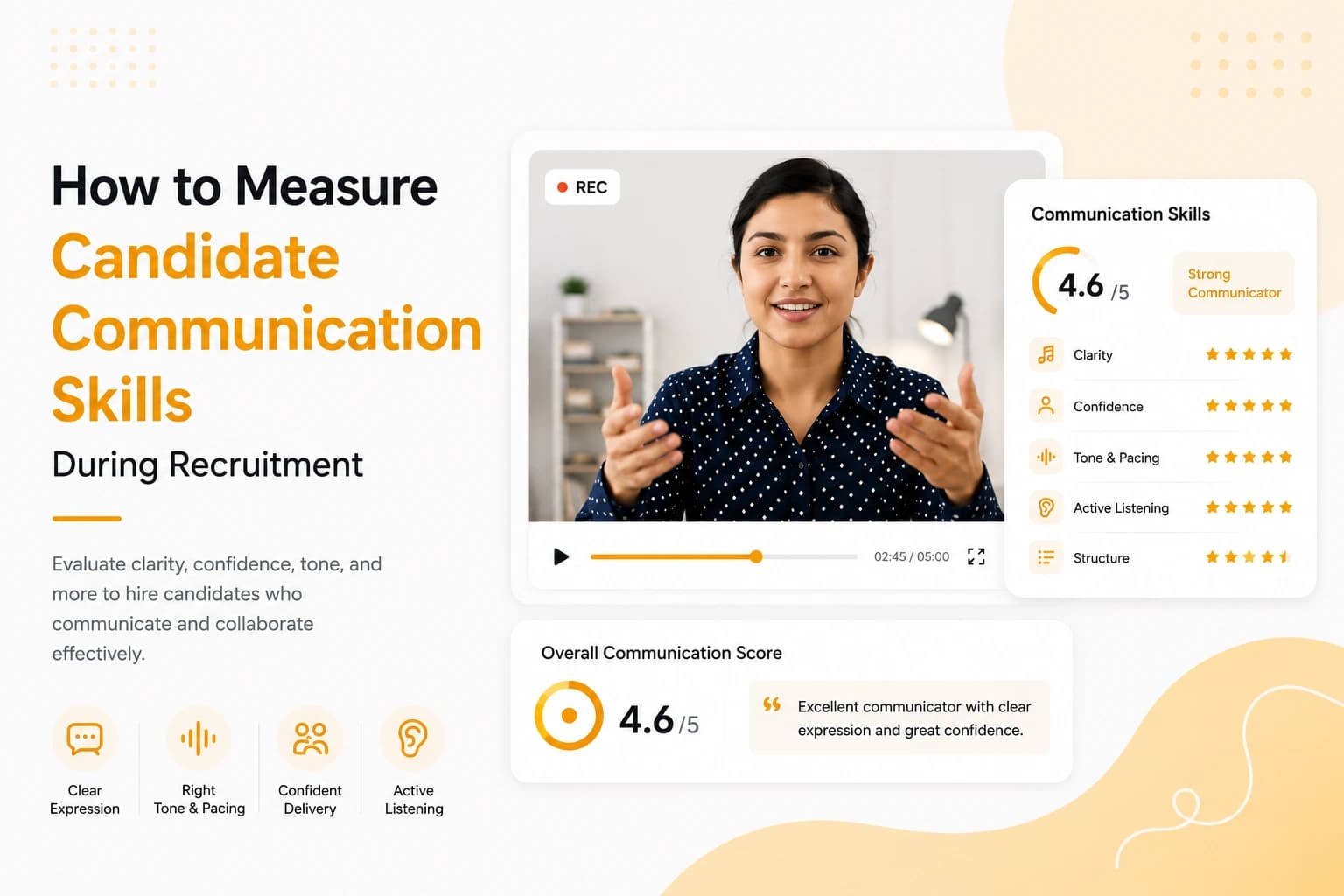
AI video screening fills that gap. By analyzing recorded responses, an AI hiring platform can assess tone, clarity, and communication patterns, giving hiring managers real insight into soft skills long before a live interview even happens.
Challenge #7: Resume Screening Fatigue
Reviewing resume after resume for hours leads to fatigue, and fatigue leads to mistakes. Strong candidates get overlooked simply because they were reviewed at the end of a long day.
Unlimited AI resume analysis removes this fatigue entirely. The system reviews every resume with the same level of attention, whether it's the first application or the thousandth, keeping resume screening accurate and consistent at any volume.
Challenge #8: Lack of Data-Driven Decisions
Many hiring decisions are still based on gut feeling rather than data. Without recruitment analytics, it's difficult to know which sourcing channels perform best, where candidates drop off, or how long each hiring stage really takes.
Modern recruitment software provides dashboards and interview analytics that turn hiring into a measurable process. Hiring managers can track time-to-hire, candidate ranking trends, and screening outcomes to continuously improve their hiring process.
Challenge #9: Coordinating Interview Schedules
Coordinating calendars across candidates, hiring managers, and interview panels is one of the most time-consuming parts of recruitment. A single scheduling conflict can delay a hire by days.
One-way video interviews eliminate most scheduling headaches by letting candidates complete interviews asynchronously. This is one of the simplest but most effective forms of hiring automation available today.
Challenge #10: Retaining Top Talent Post-Hire
Hiring the right person is only half the battle, retention starts at the screening stage. A poor fit that slips through candidate screening often leads to early turnover, costing the company time and money all over again.
By combining AI resume analysis with AI behavioral scoring, hiring managers get a fuller picture of both skill and fit before an offer is made, reducing the chances of a mismatched hire and supporting long-term talent acquisition goals.
Traditional Hiring vs AI Hiring
The difference between traditional recruitment and AI-driven recruitment becomes clear when you compare them side by side. In traditional hiring, resume screening is manual, slow, and inconsistent; interview scheduling means back-and-forth email coordination; candidate evaluation is subjective and interviewer-dependent; time-to-hire stretches from weeks to months; and decisions are based on memory and notes.
With AI hiring, resume screening happens instantly through AI resume analysis with ranked results, scheduling is replaced by self-service one-way video interviews, candidate evaluation is grounded in structured AI behavioral scoring, time-to-hire shrinks to days thanks to hiring automation, and every decision is backed by recruitment analytics and standardized interview questions for all candidates.
AI hiring doesn't replace the hiring manager's judgment, it removes the repetitive, time-consuming work so that judgment can be applied where it matters most.
Benefits of AI Hiring
Adopting AI recruitment tools delivers measurable benefits across the entire hiring process, from the first application to the final offer, including faster candidate screening through AI resume analysis, reduced time-to-hire with automated first-round screening, more consistent and bias-aware candidate evaluation, deeper insight into soft skills via AI video screening, better hiring decisions backed by recruitment analytics, and an improved candidate experience through flexible interview formats.
Why Hiring Managers Choose VideoPitcher
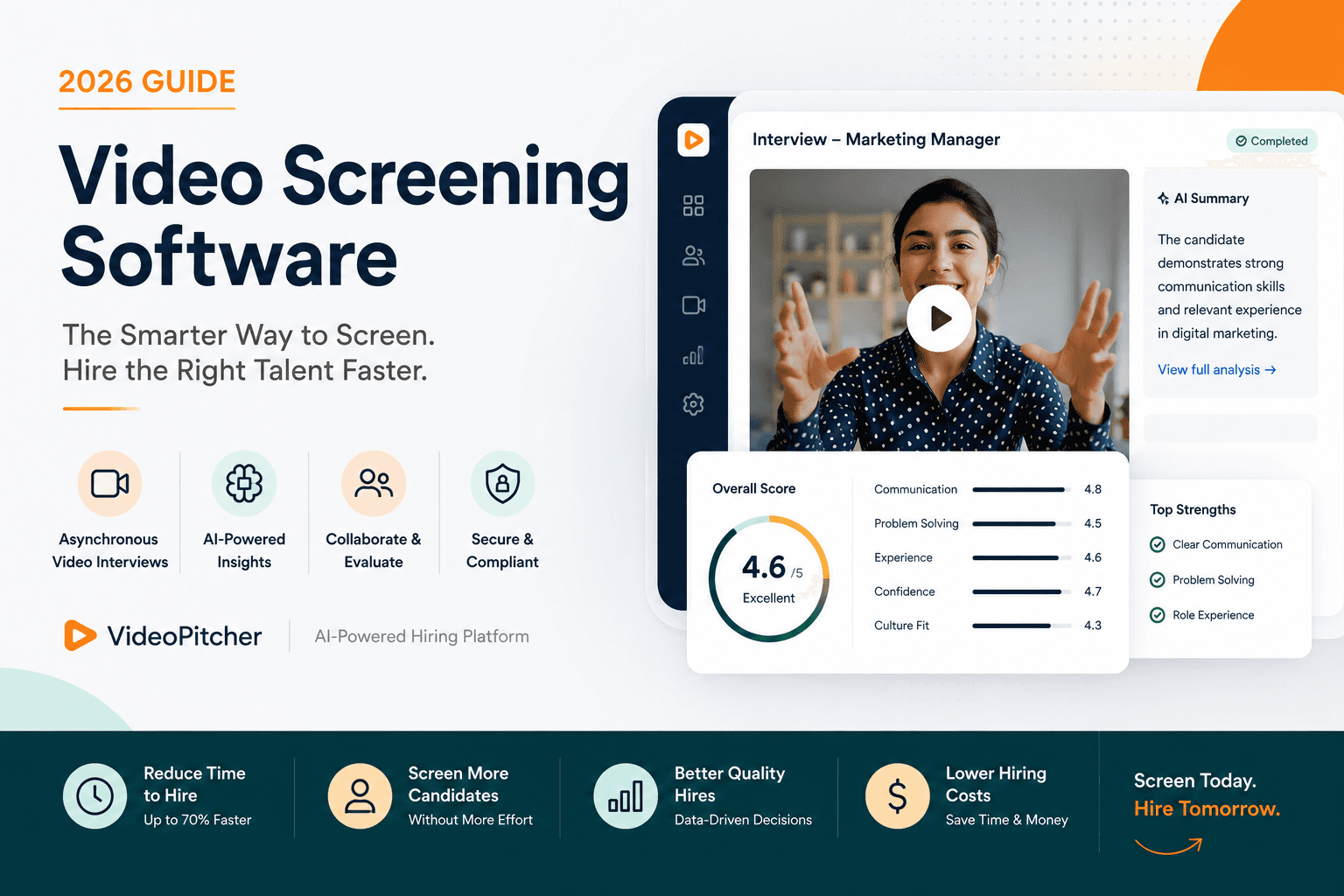
VideoPitcher was built specifically to solve the everyday problems hiring managers face. It combines AI video screening, unlimited AI resume analysis, and unlimited text screening assessments into a single AI interview platform, so hiring managers no longer need multiple disconnected tools.
With AI behavioral scoring and automatic candidate ranking, hiring managers can instantly see who stands out, without manually comparing every application. The recruiter dashboard brings all candidate data, interview analytics, and screening results into one place, making candidate management effortless.
Because VideoPitcher is ATS friendly, it fits directly into existing hiring software and workflows rather than replacing them. And with one-way video interviews built in, candidates can complete interview questions on their own time, making the entire hiring process faster and more convenient for everyone involved.
New accounts get 20 free AI video screening credits, plus unlimited AI resume analysis and unlimited text screening assessments, with no credit card required to get started.
Best Practices for AI-Driven Hiring
AI hiring works best when it's used to support human judgment, not replace it entirely. The checklist below outlines a few best practices to help hiring managers get the most out of any AI recruitment platform.
Scorecard — implementation checklist
- Use AI resume analysis to shortlist, but let humans make the final call
- Keep interview questions consistent across all candidates for fair candidate evaluation
- Review AI behavioral scoring alongside resumes, not in isolation
- Regularly check recruitment analytics to spot bottlenecks in the hiring process
- Communicate clearly with candidates about how one-way video interviews work
- Continuously refine job descriptions so AI resume screening stays accurate
- Pilot a new assessment with one role before rolling it out company-wide
- Track completion rates to spot and fix friction in your screening flow
Frequently asked questions
What is AI hiring?+
AI hiring refers to using artificial intelligence tools, such as AI resume analysis and AI video screening, to automate and improve parts of the recruitment process, including candidate screening and evaluation.
How does AI video screening work?+
AI video screening analyzes a candidate's recorded responses to interview questions, evaluating communication style, clarity, and other behavioral signals to help hiring managers assess soft skills earlier in the hiring process.
Can AI resume analysis replace a hiring manager?+
No. AI resume analysis is designed to support hiring managers by ranking and shortlisting candidates faster, while the hiring manager still makes the final hiring decision.
What is a one-way video interview?+
A one-way video interview lets candidates record their answers to interview questions on their own schedule, without needing to coordinate a live call with the hiring manager.
Is VideoPitcher ATS friendly?+
Yes, VideoPitcher is built to be ATS friendly, allowing it to integrate smoothly with existing hiring software and recruitment workflows.
How does AI hiring reduce time-to-hire?+
By automating resume screening, interview scheduling, and initial candidate evaluation, AI hiring removes many manual steps, significantly reducing time-to-hire compared to traditional recruitment.
What is AI behavioral scoring?+
AI behavioral scoring evaluates signals like communication clarity, confidence, and engagement in a candidate's video responses, giving hiring managers a consistent, structured way to compare candidates.
Does AI scoring make the final hiring decision?+
No. AI-generated insights are designed to support the hiring manager's judgment, giving hiring teams consistent, comparable signals to review, not to replace the human decision at the end of the process.
Is there a free trial for VideoPitcher?+
Yes. New accounts get 20 free AI video screening credits, along with unlimited AI resume analysis and unlimited text screening assessments, and no credit card is required to sign up.
Written by VideoPitcher Team
Recruitment Product & Research
The VideoPitcher team writes about hiring workflows, candidate assessment, and what we learn building the product.
Published July 17, 2026
Keywords covered
Related resources
Ready to transform your hiring process?
Start using VideoPitcher today with 20 FREE AI Video Screening Credits, plus Unlimited AI Resume Analysis and Unlimited Text Screening Assessments. No credit card is required—just start screening smarter and find the right candidates faster.